
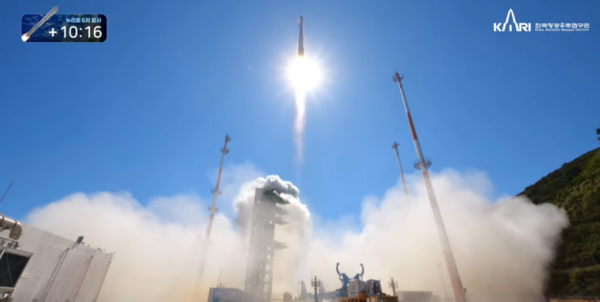
South Korea's Korea AeroSpace Administration and the Korea Aerospace Research Institute said on Monday that all 9 secondary payload satellites on the Nuri launch vehicle's fifth flight, launched on Oct. 7, have successfully established communications.
Nuri flight 5 was launched at 12:25 p.m. on Oct. 7. Of 10 secondary payload satellites onboard, 9 were deployed normally, while 1, 'Quaternion PerSat-2', was not deployed.
All 9 satellites that separated normally have successfully established communications with ground stations and are undergoing checks to carry out their missions. Of those, 6 achieved two-way communications and the remaining 3 achieved data reception (downlink). Space Lintech's 'B-1012', KARI's 'Domestic Devices and Components Space Verification Platform No. 2', the Unmanned Exploration Institute's 'Ulysses', and Space&Bean's 'SD1Sat' achieved two-way communications on their first contact attempt on launch day.
Chosun University’s 'Space Optical Communication Orbit Verification Satellite' also achieved two-way communications at around 11 p.m. on launch day, securing satellite status and operational data. Daejeon Metropolitan City's 'DaejeonSat-1' achieved two-way communications at around 11 p.m. on Oct. 8 and confirmed its solar panels deployed normally.
OnnB Space's 'Sledge', CosmoWorks' 'Jack-007' and KAIST's 'GBSat' succeeded in downlink by transmitting data from the satellites to ground stations. Sledge and GBSat are currently attempting data uplink for two-way communications.
After completing basic status checks, the secondary payload satellites will proceed through an initial operations phase to confirm systems are normal before entering full-scale missions.
Oh Tae-seok (오태석), head of the Korea AeroSpace Administration, said, "In this fifth Nuri launch, we succeeded in establishing communications with the CubeSats in a much shorter time than in the fourth launch." He said, "This is an achievement made possible because the launch vehicle inserted the satellites into their target orbits more accurately and provided precise satellite position information."
 Jin-ho Lee (이진호)
jhlee26@d-today.co.kr
Jin-ho Lee (이진호)
jhlee26@d-today.co.kr