
[Digital Today reporter Sangyeop Oh] South Korean stocks are expected to try again to settle above the 7,000 mark on the KOSPI this week. Semiconductor earnings and shareholder returns are supporting the downside, while August export data and U.S. employment figures are expected to determine whether the rebound continues.
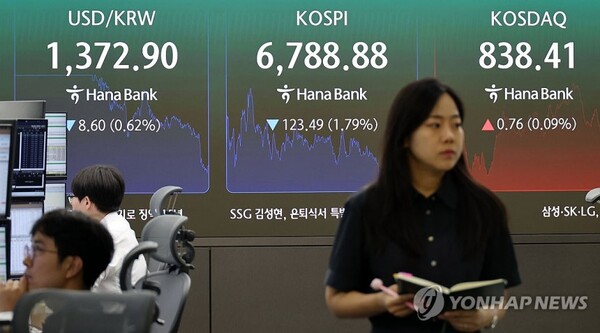
The KOSPI closed at 6,788.88 on Aug. 28, down 123.49 points, or 1.79 percent, from the previous session. The Kosdaq ended at 838.41, up 0.76 points, or 0.09 percent. The KOSPI halted a three-session run of gains. Samsung Electronics and SK Hynix fell 3 to 4 percent, while foreign and institutional investors sold in tandem, dragging the index lower.
U.S. stocks also fell on rate worries. On Aug. 28, local time, the S&P 500 fell 0.25 percent, the Nasdaq dropped 0.52 percent and the Dow Jones Industrial Average slipped 0.02 percent.
The move followed remarks by U.S. Federal Reserve Chairman Kevin Warsh at Jackson Hole that additional policy action could be needed if inflation does not clearly come down to the target level, raising the likelihood of a September rate hike.
The industry, however, does not see the domestic market’s fundamentals as being damaged. The KOSPI rebounded after a sharp drop in July, led by semiconductors, and more recently the positive tone has spread to non-chip sectors. Rather than quickly clearing 7,000, the index is more likely to move within a range as sector rotation continues, the view says.
The first data point to watch this week is August exports, due on Sept. 1. Exports for Aug. 1 to 20 were $55.2 billion, up 56.0 percent from a year earlier. Daily average exports, adjusted for working days, rose 61.5 percent. Semiconductor exports surged 198.8 percent to $26.03 billion, the highest ever for the Aug. 1 to 20 period. Chips’ share of total exports rose to 47.2 percent.
The market sees full-month August exports likely to continue growing in the 60 percent range from a year earlier. In a recent survey of experts, the forecast for August export growth was put at 62.6 percent. If exports match expectations, it could lift earnings expectations again for heavyweight chip stocks such as Samsung Electronics and SK Hynix.
Semiconductors remain the KOSPI’s key leading sector. Nvidia recently presented an earnings outlook that beat market expectations, easing concerns about a slowdown in AI data center investment, and SK Hynix also expects the memory supply shortage to persist for a considerable period.
If foreign investors sell heavyweight chip stocks on a large scale, as they did on Aug. 28, index volatility could rise again.
The industry sees a broader shift into non-chip sectors if semiconductors pause. During the recent index rise, buying moved into construction, machinery, cosmetics and apparel, and financials.
Analysis suggests that how broadly gains spread across stocks, rather than the pace of the index’s rise itself, could be a benchmark for judging market normalization.
Expanded shareholder returns are also a factor supporting the downside. SK Hynix decided to buy back 40 trillion won of its own shares and cancel all of them, and to return more than 50 percent of cumulative free cash flow from 2025 to 2027 to shareholders.
Samsung Electronics also decided to carry out about 90 to 110 trillion won in shareholder returns this year. That is about five times the previous record of 20.3 trillion won set in 2020.
There are also expectations that heavyweight chip stocks could ease the chronic undervaluation of South Korea’s stock market by expanding shareholder returns through buybacks and dividends, in addition to profit growth.
In the short term, U.S. interest rates are the biggest variable. After Warsh’s Jackson Hole speech, the market-implied probability of a September rate hike has risen to around 55 percent.
The yield on the U.S. two-year Treasury has also jumped to the 4.3 percent range. If rates rise quickly, they reduce the present value of future earnings, which can weigh on semiconductors and growth stocks.
Attention is expected to shift to the U.S. August employment report due on Sept. 4. U.S. employment fell last month, contrary to expectations, so this result could affect the policy decision of the Federal Open Market Committee in September.
If employment and wages are stronger than expected, the likelihood of a rate hike could rise, but if a suitable degree of slowdown is confirmed, bond yield pressure could ease.
Monetary policy meetings in major economies including the United States and Japan are also scheduled in September. The U.S. FOMC is set for Sept. 16, local time, and the Bank of Japan is due to make a policy decision on Sept. 18. Oil price volatility linked to conflict between the United States and Iran also remains, suggesting the market’s sensitivity to rates could stay elevated for some time.
The Kosdaq is expected to see stronger differentiation by stock than by the index. Price burdens have eased significantly after the sharp drop in July, but stocks with improving earnings prospects are likely to fare better than theme-driven rebounds unrelated to performance. If rotation continues from semiconductors to other sectors, there is room for an improvement in supply and demand in the Kosdaq as well.
Ultimately, this week’s market is expected to focus less on breaking above 7,000 itself than on whether flows and earnings support the move. If August exports reaffirm expectations for semiconductor earnings and U.S. jobs data do not raise rate worries, the KOSPI could try again to settle above 7,000. If U.S. Treasury yields rise further and foreign selling of semiconductors continues, the index may repeatedly move within a box range.
Kyung-min Lee (이경민), a researcher at Daishin Securities, said, "As the concentration of semiconductor flows eases and sector rotation continues, the uptrend is expected to persist." He added, "In the short term, the key is whether the KOSPI can settle in the 6,500 to 6,800 range, and if it succeeds, it could leave open the possibility of a recovery to 8,500, which corresponds to a 12-month forward price-to-earnings ratio of 7."
Jaewon Lee (이재원), a researcher at Yuanta Securities, said, "For the time being, a rotational market is expected to continue at the level of individual stocks." He added, "Each time share prices fall, demand for shareholder returns based on companies’ low valuations could support the downside of the index."
 Sangyeop Oh
yub@d-today.co.kr
Sangyeop Oh
yub@d-today.co.kr