
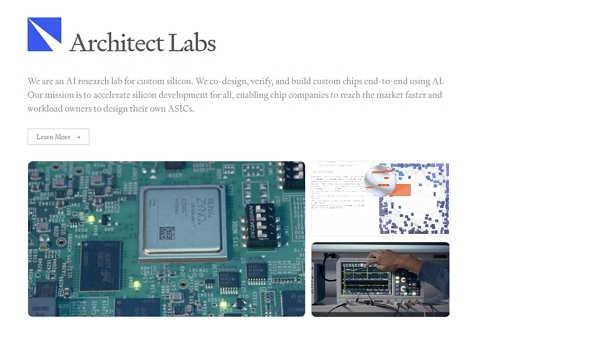
Can AI cut the time needed to design semiconductors from more than a year to just 2 weeks? U.S. startup Architect Labs has drawn industry attention after claiming it used AI to finish the design and verification of its in-house chip, Redwood, in 2 weeks.
Business Insider reported on Aug. 27 that Architect Labs developed Redwood by having AI carry out detailed design work while two chip architects set and revised the overall structure and direction. The company said it greatly shortened the development cycle, given that chip development typically takes more than a year, costs hundreds of millions of dollars and requires around 100 specialists.
Architect Labs is a young company founded in 2025. Co-founder and CEO Ebrahim Hussain (에브라힘 후세인) pointed out that while AI models are advancing quickly, the pace of semiconductor development to run them is not keeping up. The company disclosed a $24 million seed round led by Kindred Ventures as it emerged from stealth mode in June. TQ Ventures, Race Capital and Together Fund participated, and figures from the AI and semiconductor industries, including Jeff Dean (제프 딘), also invested.
Redwood is designed to run large AI models such as Meta's Llama and Alibaba's Qwen. But it is not yet a chip produced as actual silicon at TSMC. It is currently at the stage where the design has been implemented on an FPGA, a reconfigurable semiconductor, and testing has been completed. Based on the test results, Architect Labs claimed the final product could deliver higher efficiency than Nvidia's Jetson Orin Nano used for edge AI such as robots.
Outside experts focused on the development speed but assessed that actual manufacturing is the key verification step. Hao Zheng (하오 정), a professor at the University of Central Florida, called the 2-week timeframe impressive, but said existing companies such as Synopsys and several startups are also using AI for semiconductor design. Zheng said speed, power efficiency and reliability can be properly confirmed only after an actual chip is produced.
The possibility of AI errors is also a variable. Matthew Guthaus (매슈 거트하우스), a professor at UC Santa Cruz, said AI already shows strengths in several areas of chip design but can make unexpected mistakes, requiring close supervision and re-verification. Design flaws not found before manufacturing can lead to losses of millions of dollars. Hussain said the company's AI system was built to verify design errors on its own, instead of leaving verification entirely to humans.
Architect Labs sees the potential for a virtuous cycle in which design and AI improve each other, as AI identifies areas to improve Redwood itself. The company said AI continues to revise the design and it has not yet decided when to commission production at TSMC.
Hussain said the semiconductor industry could move beyond fabless operations without factories to a designless era that also reduces reliance on large human design organizations. Still, whether Redwood can prove its current performance claims after actual manufacturing is expected to be the first test of the potential of AI-based semiconductor design.
 Jae-won Choi
ittt_0801@d-today.co.kr
Jae-won Choi
ittt_0801@d-today.co.kr