
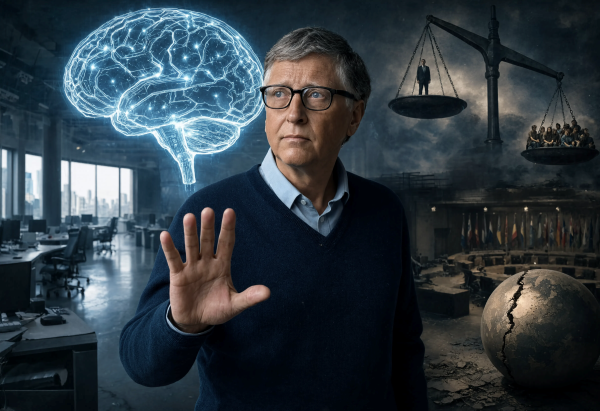
[DigitalToday Seung-a Yoo] Microsoft (MS) co-founder Bill Gates (빌 게이츠) has retreated from his earlier optimism about artificial intelligence (AI), issuing a strong warning about jobs, inequality and a global governance vacuum.
On Aug. 26 (local time), The Verge and other foreign media reported that Gates said in an essay of about 6,000 characters that the world is not prepared at all for the spread of AI and that it is “not even preparing.”
The piece differs from his previous stance in 2023, when he viewed AI relatively optimistically. Gates assessed the impact AI could have on humanity’s shared future much more pessimistically. He said AI would “either become the greatest equalising force ever invented, or the worst source of injustice,” and predicted the shift to a new AI era would be “one of the most tumultuous periods in human history.” He added, “If someone has a credible plan to slow AI development worldwide, I would probably support it.”
◆ “This time is different”... warning focuses on employment shock
Gates pointed especially to an employment shock as the central risk. He said many people are underestimating the impact because of the performance limits of current AI models or comparisons with past innovations such as the PC, and argued this change is different in nature from past technology diffusion. He warned that “many jobs will disappear permanently.” He judged that the risk of replacement could spread across both white-collar and blue-collar work. He urged political leaders to act before soaring unemployment, damage to local communities and erosion of public trust appear.
Based on those concerns, Gates also offered relatively specific policy proposals. He noted that companies pay taxes on wages when they hire employees, but can usually write off robot purchases immediately as business expenses, and said the tax system is encouraging the replacement of people with machines. He proposed taxing AI tokens and robots to slow that trend and using the funds for retraining and strengthening social safety nets.
He also said some jobs need to be designated as human-only areas and left to people. He said that includes economic reasons, such as being unable to expect satisfaction by telling a 55-year-old worker who spent a lifetime in construction to work at a care facility, and areas that should not be delegated even if robots technically could, such as diagnosing incurable diseases. He added the human-only scope could change over time, and it may be worth considering designating some jobs first and introducing AI in stages over several years to several decades. Still, there is also an assessment that both proposals could significantly hurt profits at major AI companies, and appear to have been rarely discussed in the industry so far. Who would set such rules and what they would specifically include have not yet been settled.
◆ “Existing systems are not enough”... calls for new international body
Gates also said it would be difficult to manage AI with existing systems. Because AI simultaneously affects taxation, labour, health, national security and education, he said it is hard for traditional organisations centred on individual ministries to see the full risks. He argued that dedicated bodies are needed within governments to coordinate priorities and oversee risks.
He said an international organisation is also needed to address cross-border risks. He did not present a specific plan for which risks to manage and with what structure. He said the body could draw some hints from international agreements on nuclear issues, aviation and ozone protection, while adding it would be “different from any institution we have made so far.” He also acknowledged cooperation between the United States and China would be unavoidable, but did not explain an execution path. Instead, he urged starting discussions now on establishing an international organisation, saying, “We do not have the luxury of moving slowly.”
Gates also mentioned “Pacing the Frontier” and expressed sympathy. It is an open letter released by AI industry workers calling for adjusting the speed of AI development. Gates agreed with the flow while taking a sceptical view of its sustainability. That stance, an assessment says, mirrors Anthropic’s policy line in that it expresses hope for AI’s usefulness in science and medicine while fearing an employment shock.
Gates has been relatively quiet in recent public discussions about AI. This essay is close to a declaration that he will break that silence. He said he would use his time and influence to put AI and equity issues on a bigger public agenda. He also said he would raise the issues whenever he visits Washington, D.C., or meets world leaders.
He also said he would soon explain additional ideas to ensure AI’s benefits outweigh its harms, as well as the Gates Foundation’s plans to use AI. The essay is read as a signal that Gates will return to the forefront of the AI debate, placing greater weight on managing social impact and designing institutions than on technology optimism.
 Seung-a Yoo
ysah@d-today.co.kr
Seung-a Yoo
ysah@d-today.co.kr