
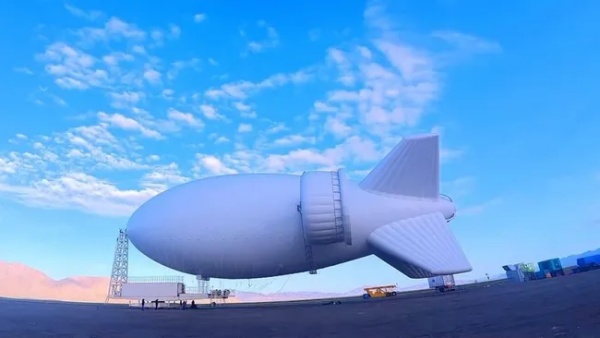
[Digital Today reporter Jinju Hong (홍진주)] China has succeeded in a test of a helium airship that generated electricity at an altitude of 4,000 metres and returned to the ground.
Tech outlet TechRadar said on Aug. 27 (local time) the test was introduced as the world’s first, and the craft was said to be similar in length to a Boeing 747.
The test vehicle is called the S4000, named for its ascent to an altitude of 4,000 metres. The airship produces electricity by using turbines mounted on both sides of the craft to capture high-altitude winds. It sends the power it generates to a ground base through a long tether.
The key is using winds at higher altitudes than on the ground. The S4000 is designed to generate power aloft, where winds are stronger and more consistent than near the surface. CCTV reported the airship completed one test cycle from ascent to power generation and return.
The high-altitude airship approach also touts operational flexibility that differs from existing fixed wind turbines. The S4000 can move to areas with stronger winds as needed. That means it can adjust its location to match changes in wind conditions or move to where more power is needed. It is also cited as a feature that it does not occupy large areas of land. It can reduce the space taken up by wind farms and may also lower the burden of complaints surrounding onshore wind facilities.
China's Sawes Energy Technology and Tsinghua University, as well as the Aerospace Information Research Institute under the Chinese Academy of Sciences, took part in the development. The S4000 is not a single prototype but an extension of earlier models. Earlier models, the S1500 and S2000, were reported to have secured orders totaling 500 million yuan, about $74.3 million. The S4000 was introduced as being set for broader deployment beyond the testing stage.
The result also shows wind technology is not remaining limited to large onshore facilities. A portable wind turbine introduced the same week, the Ventira R1, can be folded enough to fit in a backpack while delivering 50 watts of output. It was presented as taking about 35 minutes to fully charge a connected smartphone. This suggests wind technology is expanding at the same time into ultra-large facilities and small mobile devices.
In this trend, the significance of the S4000 goes beyond a simple test success. China verified with an actual airship a method of producing megawatt-class power by harnessing strong and stable winds aloft. It also presented an alternative that can reduce the siting and space problems that existing wind power has faced. The point to watch is how quickly the airship moves beyond the test stage into actual grid operations or large-scale deployment.
 Jinju Hong (홍진주)
hongjj@d-today.co.kr
Jinju Hong (홍진주)
hongjj@d-today.co.kr