
Sodium-ion batteries are emerging as a next alternative in the grid energy storage system (ESS) market, electric vehicle outlet Cleantechnica reported on Aug. 26. Sodium-ion batteries are moving into the lithium-ion-dominated storage market, supported by lower raw material costs, low-temperature performance and reduced cooling demand.
The key is that their characteristics are better suited to energy storage systems than to electric vehicles. Sodium-ion batteries have lower energy density than nickel-manganese-cobalt (NMC) chemistries, which is a disadvantage for high-performance electric vehicles, but the situation differs for stationary storage. They require little to no complex cooling systems, or allow scaling them down, reducing space and cost burdens. With lithium supply chains concentrated in China, they are also drawing attention in the United States and Europe as an option to diversify supply chains.
Market forecasts are also growing quickly. Morgan Stanley Research estimated earlier this year that sodium-ion batteries will reach 2 percent of installed-base market share in 2027, then expand to 20 percent in 2030 and 37 percent in 2035. Lithium-ion currently accounts for 95 percent of the 2-hour to 8-hour discharge segment, but the start of alternative technologies entering the actual product stage is being read as a sign of change.
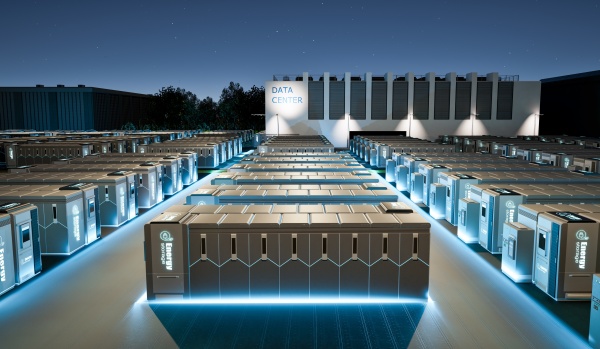
U.S. company ESS plans to unveil next year its first grid design using sodium-ion batteries. The company plans to use NFPP cells from Boston-based cell developer Alsym to assemble a 1.2 MWh AC storage system called Bridge at its Oregon manufacturing facility. Randy Selesky (랜디 셀레스키), ESS chief business officer, said of NFPP, "It matches the characteristics ESS has pursued from the start in that there is no fire risk and it is safe." ESS also plans to release a follow-on product with higher energy density by the end of 2028, after its first launch in 2027.
ESS drew a line, saying the move is not a downsizing of its long-duration flow battery business. Selesky said, "Lithium still accounts for 95 percent of the market," and "We saw it as the first product that can compete head-on with traditional lithium-ion use cases." ESS is taking a dual strategy, shifting the focus of research and development to flow batteries in the 16-hour to 48-hour discharge segment while responding to the short- to medium-duration storage market with sodium-ion batteries.
Peak Energy also expected to begin supplying its GS1 storage system from mid-2027. The company presented the passive cooling structure of sodium-ion batteries as a key competitiveness factor. Chief science officer Brandon Kelly (브랜던 켈리) said of cooling systems, "They require moving parts and refrigerant, filters and fans, and they are noisy," adding that lithium-ion must accept this, but sodium-ion can maintain lifespan at higher temperatures. He added that passive cooling systems can retain 85 percent state of health after 20 years, while lithium-ion would be at about 65 percent even with liquid cooling.
Moves are also emerging targeting the residential storage market. Unigrid, which started at the University of California San Diego, decided to produce NCO batteries in the United States with manufacturer Syntropic Power. Darren Tan (대런 탄), Unigrid co-founder and chief executive, said of the NCO chemistry, "It has everything: lifespan, safety, power output and cost." Unigrid sees the residential storage market, where the influence of large Chinese companies is relatively weaker, as its target.
The cost structure also differs from lithium-ion. Unigrid sees sodium-ion batteries as having a lower share of raw material costs and a higher share of manufacturing costs than lithium-ion, leaving more room for prices to fall once production processes are established. Tan forecast that current prices are still higher than lithium-ion but will drop sharply over the next 5 to 10 years.
Against this backdrop, sodium-ion batteries have moved beyond a simple experimental stage and are entering a phase of preparing to enter the commercial storage market. For grid use, safety and lower cooling costs are emerging as key variables for expansion. For residential use, the potential for price declines and supply-chain diversification are coming to the fore.
 Jinju Hong
hongjj@d-today.co.kr
Jinju Hong
hongjj@d-today.co.kr