
Kakao's labour union has formalised its opposition to a planned corporate spin-off that would split the company into KakaoX and KakaoAI, and said it will move to defeat the proposal at a shareholders meeting. It will also pursue joint bargaining at the Kakao group level separately from talks at individual affiliates.
Kakao has presented boosting corporate value and improving efficiency in decision-making and capital allocation as the main purposes of the spin-off. The union, however, says follow-up plans on employment, organisational operations and the roles of each affiliate have not been sufficiently disclosed after the split, and is demanding detailed explanations and consultations.
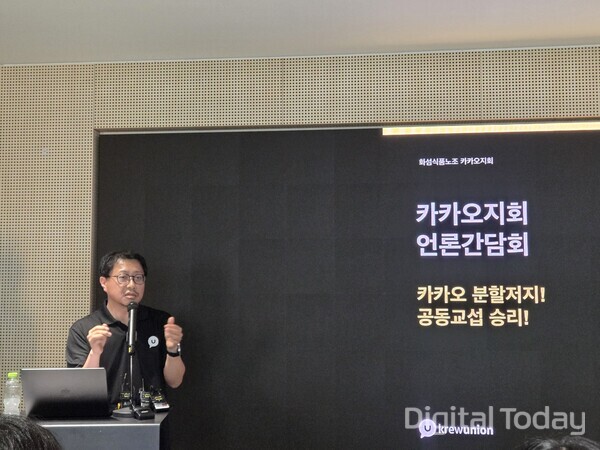
The Kakao branch of the Korean Federation of Chemical, Textile and Food Industry Workers' Union held a rally on Aug. 26 near Pangyo Station in Seongnam, south of Seoul, declaring opposition to Kakao's split and the launch of joint bargaining. It later held a press briefing and stated its position.
Kakao branch head Seung-wook Seo (서승욱) said the union opposes the current spin-off plan. He said it was difficult to accept an approach in which the company first puts forward a split plan and then says it will resolve issues afterward, rather than presenting the split as a way to solve identified problems.
◆Union seeks explanation of need for split, follow-up measures
Kakao on Aug. 21 announced a plan to split Kakao into KakaoX and KakaoAI through a corporate spin-off.
The union says it is difficult to view any damage to corporate value and the causes of issues seen in existing management processes as stemming only from the complexity of the business structure. It argues that an assessment of the existing decision-making system and measures to improve it should also be presented along with the split plan.
Seo said employment is an issue, but what matters is how much the current split plan can solve the problems that emerged during the existing reform process. He said it must include ways to prevent existing problems from being repeated.
The union is also seeking additional explanations on the roles of KakaoX and KakaoAI and staff allocation after the split. According to the union, management at each entity conveyed messages to employees after the split announcement, but details on organisational changes and staffing were limited.
The union said in particular that the scope of personnel to be moved to KakaoAI has not yet been finalised. It is demanding that, before an extraordinary general meeting of shareholders planned for December, Kakao disclose how the spin-off will affect employment and working conditions at Kakao and major affiliates and consult on related matters.
◆Pushing to defeat proposal at shareholders meeting, persuading investors including NPS
The union plans to communicate its opposition to the spin-off during the shareholders vote.
As the agenda item requires a special resolution at a shareholders meeting, it plans to explain the issues it has raised to institutional investors and minority shareholders and secure votes against the proposal.
Seo said the specific schedule needs further discussion, but persuading shareholders other than the controlling shareholder to draw out opposition votes could be a way forward.
He mentioned the National Pension Service as an initial contact. Seo said he would first try to meet with the pension fund and, considering Kakao's proportion of individual shareholders, there was also a need to talk with many citizens.
The union has not yet finalised specific forms of collective action or a schedule. It has set the broad direction of opposing the split and pushing joint bargaining, and will work out details after further discussions.
◆Joint bargaining sought for issues common across affiliates
Another pillar of the union's push is joint bargaining at the Kakao group level.
The union says some matters require individual bargaining because wage levels and detailed systems differ by entity. It says joint bargaining is needed for matters that apply across multiple affiliates, such as job security and organisational restructuring, responsible management, and the basic direction of the compensation system.
It presented proposed joint bargaining agenda items including responsible management and job security, fair distribution of performance-based rewards, prior consultation in cases of restructuring, sales or spin-offs, transfers within the group, and group-wide employment and welfare safety nets.
The push for joint bargaining is not a new demand arising from the spin-off announcement. The union says it has been preparing group-level joint bargaining since May and that the split has increased the need for it.
Sung-eui Park (박성의), head of the Kakao union's struggle headquarters, said this was not about how to bargain separately with KakaoX and KakaoAI, but about viewing Kakao as a whole at the union branch level. He said the union has been preparing joint bargaining since May.
For joint bargaining to happen, the company must respond to the request for talks. The union also said it has not finalised all details on the counterpart and the method for joint bargaining.
The union plans to deliver its joint demands to the company and request talks on the day. It plans to decide the direction of pushing joint bargaining based on the company's reply, and also to prepare an internal action plan to oppose the spin-off within the month.
Key issues going forward are how specifically Kakao will flesh out employment and organisational operations plans tied to the spin-off and what stance it will take on the demand for joint bargaining. As the union has said it will push to defeat the split proposal at the extraordinary shareholders meeting in December, the consultation process between the company and the union is expected to continue until before the meeting.
 Ho-jeong Lee
lhj@d-today.co.kr
Ho-jeong Lee
lhj@d-today.co.kr