
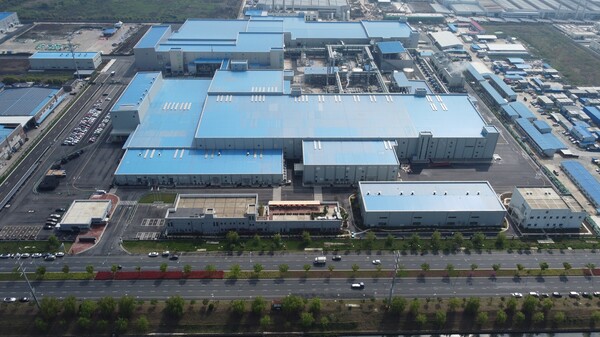
SK Innovation plans to absorb SK IE Technology (SKIET) as a business division to generate an annual 60 billion won improvement in earnings before interest, taxes, depreciation and amortisation (EBITDA). It plans to consolidate overlapping organisations, narrow production and marketing functions around core customers, and lower SKIET’s interest costs by leveraging SK Innovation’s credit standing.
At a merger briefing held on Tuesday, Kim Yun-hoe (김윤회), head of SK Innovation’s corporate strategy office, said the cost-saving effect created immediately by the merger would total about 60 billion won a year. He said the company would continue to find additional cost-cutting items.
Once the merger is completed, SKIET will be dissolved and its separator business will become a business division of SK Innovation. Kim said the separator business would be structured as a business division, and that decision-making on strategy, investment, production and sales would be unified within SK Innovation. The merger date is Jan. 1, 2027.
The company presented different targets for a return to profitability depending on the metric. Kim set a goal of turning the separator business EBITDA positive within 2 to 3 years. On an operating profit basis, it expects to turn to an operating profit in 2029.
The demand focus is separators for energy storage systems (ESS). ESS facilities store electricity and supply it when needed, and could be an outlet for separator sales while a recovery in electric-vehicle demand is delayed. Kim said the company would increase production of ESS separators in line with an expansion of SK On’s ESS business.
SKIET’s situation, unable to sell or inject capital... the reason is 20% utilisation
Ahead of the planned absorption, SK Innovation reviewed four alternatives. Seo Geon-gi (서건기), head of SK Innovation’s finance division, said of a sale to a third party that demand to acquire a listed company was low and the separator business had low market appeal, making it difficult to secure a buyer. He also cited the time needed for buyer searches, due diligence and negotiations.
The remaining three options were also ruled out in turn. Lending funds would raise both SKIET’s debt ratio and interest costs, while an equity injection would create a financial burden for SK Innovation and dilute the equity value of SKIET’s existing shareholders. A comprehensive stock exchange was excluded because SKIET would remain a separate entity and would not fundamentally resolve financial risks.
Behind the decision is plant utilisation. SKIET’s first-quarter utilisation rate at its separator plants this year stayed at around 20%. Jeong Jae-seong (정재성), head of SKIET’s management support office, said separators have a cost structure with a high fixed-cost portion, so a decline in output has a large impact on profit and loss. He said it would not be easy to improve utilisation without structural change. The company cited a slowdown in the electric-vehicle market, changes in U.S. subsidy policy and price competition driven by capacity expansions by Chinese separator makers as causes.
The company also cited changes since the 2019 spin-off. Kim said that at the time of the spin-off, the company sought to maximise profits and strengthen expertise in the separator business on the premise of rapid growth in the electric-vehicle market, but that premise changed after 2024 as growth slowed and North American original equipment manufacturers adjusted production plans.
SKIET is restructuring its production footprint, including selling its China plant and suspending operations at its Jeungpyeong plant. Jeong said about 2 trillion won has been invested in the Poland plant so far and new investment would be completed within this year. On multiple rounds of capital increases, he said it was not because new demand emerged, but because investment execution was split, leading to split capital increases.
No limit on capital injections... SK Innovation to assume SKIET risks
As external conditions are not positive, resolving risks and meeting the EBITDA improvement target could be delayed. Still, SK Innovation’s policy is to maintain the business without setting a limit on capital injections. Asked about the scale of additional cash 부담 if a turnaround is delayed, SKIET said it had not set any limit by assuming things would worsen and deciding how much to invest.
The plan to approve the merger by a board resolution without a shareholders’ meeting will also remain unchanged. Asked whether it reviewed holding a shareholders’ meeting, the company said the dilution effect was limited and it judged that post-merger profit and loss improvement could offset it, so it would proceed as a small-scale merger as prescribed by law. New shares to be issued in the merger amount to about 2.6% of total shares outstanding.
The two companies stressed that although they are not subject to a statutory external valuation, each voluntarily appointed external experts to review an appropriate merger ratio range using the discounted cash flow (DCF) method. They said they received a conclusion that the 1-to-0.1174540 ratio calculated based on the base market price falls within that range. A special committee composed entirely of independent directors met six times from May 27 to Aug. 25.
Separately, the shareholder return policy was put on hold. Seo said the company was unable to pay dividends for a second consecutive year due to losses, and that strengthening financial soundness remains the top priority this year. He said it would explain again at a later confirmed timing after reviewing medium- to long-term profit, net debt levels and investment plans. SK Innovation plans to hold an offline shareholder briefing on Sept. 14 to further explain the background to the merger and its 추진 plan.
 Dae-geon Seok
d2dg@d-today.co.kr
Dae-geon Seok
d2dg@d-today.co.kr