
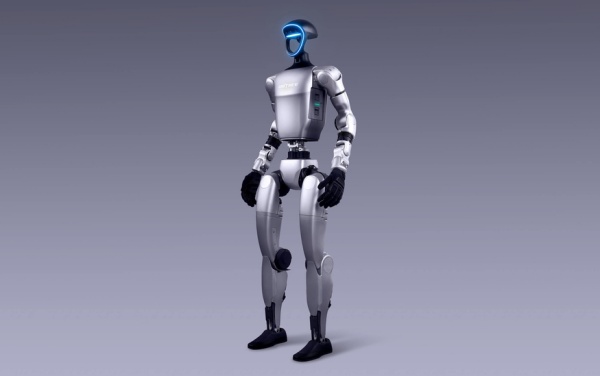
Shares of China’s humanoid robot company Unitree have fallen nearly 45% from their peak soon after listing, adding to worries that investment enthusiasm for artificial intelligence and robotics has outpaced performance and demand.
On Aug. 25 local time, blockchain media outlet Cryptopolitan reported that Unitree surged 460% on its first day of trading after listing on the Shanghai Stock Exchange on Aug. 19. It then fell for three straight sessions through Aug. 25, cutting its market value by about $30 billion from its peak.
The plunge is being seen as an example of how quickly the market prices in a robot narrative, rather than a reflection of Unitree’s technology itself. Unitree briefly reached a market capitalisation of about $66 billion on its first day. Selling pressure then continued and the shares quickly retreated, with the trend stabilising somewhat on Aug. 25.
The market shock was seen as larger because the first-day jump was well above the average for Chinese IPOs. Over the past three years, the average first-day return for Chinese IPOs was 226%, and Unitree’s gain was about double that. One month before Unitree’s listing, semiconductor company CXMT also surged 466% on its first day after listing in Shanghai, highlighting that overheating in new listings is continuing across China’s stock market rather than being limited to a specific name.
Criticism quickly turned to the listing structure. Abraham Zhang (아브라함 장), chairman of China Europe Capital, argued that the IPO was "to pump up the stock price and then offload it at a high price". He said others benefited during the listing process and retail shareholders could be left to absorb losses.
Results fell short of expectations. Unitree posted 2025 revenue of 1.699 billion yuan, and the gross margin of its core business was 60.13%. This was presented as evidence that its humanoid business is not simply at a stage of only spending money. But adjusted net profit in the first quarter of 2026 fell 53% to 40 million yuan. The company drew attention for demonstrations of robots running, dancing and performing martial arts moves, but there has also been criticism that there is not yet much commercial demand from customers who actually pay.
That has prompted a counterargument that the industry cannot be judged by profitability alone. Gao Xingkun (가오싱쿤) of China Southern Asset Management compared the robot industry to China’s electric vehicle industry, where an early loss-making phase lasted a long time, and said, "It is not fair to judge it only by profit."
China’s market structure has also been cited as a factor that amplifies price distortions. Chinese exchanges screen companies before listing and are also involved in the IPO pricing process, making it difficult for banks to adjust prices flexibly even if demand surges. Critics also say constraints on short sellers and a market structure in which investors expect regulators to protect retail shareholders could weaken checks on overvalued IPOs.
Yuan Yuwei (위안위웨이), a hedge fund manager at Trinity Synergy, described the structure by saying, "An IPO stock worth 10 yuan can start at 100 yuan and then fall for years. That is exploitation." Supply shortages also played a role. From January to July 2026, there were 21 new listings in Shanghai, compared with 104 in Hong Kong over the same period.
Still, it is also clear that Unitree is not a company without substance. Unitree is the world’s largest maker of robot dogs and the world’s No. 2 humanoid maker by shipments. Counterpoint Research said Unitree shipped more than 7,000 humanoids in the first half of 2026, taking a 31% share of the global market. Over the same period, global humanoid shipments exceeded 22,000 units, up about 300% from a year earlier.
While shipments are rising rapidly, actual demand and software completeness remain at a verification stage. Chief Executive Officer Wang Xingxing (왕싱싱) said the day after the listing that robot intelligence was getting closer to a "ChatGPT moment". He also said a meaningful software leap could take 2 to 3 years even in an optimistic view, and as long as 5 to 10 years.
Ultimately, Unitree’s sharp drop has been seen less as a rejection of the robot industry’s growth potential than as an example of how far ahead the market is pricing in a future that has not yet been realised. The gap between how quickly investors expect the robot market to expand and when companies actually generate profits is expected to remain a key variable for some time.
 Jinju Hong
hongjj@d-today.co.kr
Jinju Hong
hongjj@d-today.co.kr