
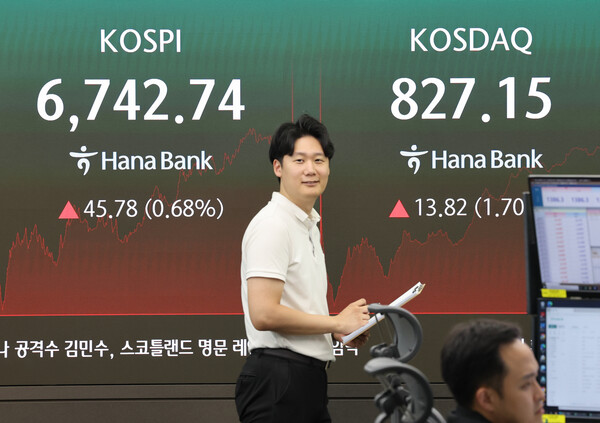
As stock market volatility increases, “debt investing” — borrowing to invest — is rising again after a recent lull. Outstanding margin loans, which had dropped to the 27 trillion won range in early August, have climbed to around 33 trillion won. Some brokerages have started their own risk controls, including lowering credit limits for very elderly investors.
According to the Korea Financial Investment Association, outstanding margin loans in the domestic stock market stood at about 33 trillion won as of Aug. 24. The KOSPI accounted for about 26 trillion won and the KOSDAQ about 7 trillion won.
The outstanding margin loan balance had swelled to 36.7 trillion won at the end of June. It fell to 27.4 trillion won on Aug. 4 during a sharp market drop, but has been rising quickly again as the market rebounds. With the market showing signs of recovery, margin loans increased by more than 5 trillion won in just 20 days.
Looking at this year’s overall trend, the rise in debt investing is even clearer. According to the Capital Market Institute, outstanding margin loans in the domestic stock market stood at 36.7 trillion won at the end of June, up 5.5 times from 6.7 trillion won at the end of 2016. The average annual growth rate was 19.6 percent, about 1.7 times faster than the 11.6 percent growth rate of margin trading in the U.S. stock market over the same period.
Another feature is that credit trading has shifted from small and mid-cap KOSDAQ stocks to large-cap KOSPI stocks. Of the margin loan balance at the end of June, the KOSPI accounted for 28.6 trillion won, or 78 percent of the total, and the KOSDAQ was 8.1 trillion won. Recently, the structure in which the KOSPI accounts for most margin loans has continued.
Credit trading has risen sharply among younger investors. According to the industry, margin loan balances for investors in their 20s and 30s stood at 4.2 trillion won at the end of June, about 2.4 times higher than 1.8 trillion won at the end of 2024.
Among those in their 20s, the balance rose about 2.5 times to 476.8 billion won from 194.2 billion won over the same period. Among those in their 30s, it increased about 2.4 times to 3.7 trillion won from 1.6 trillion won. Margin loan balances for investors in their 20s and 30s hit a record high of 4.2 trillion won at the end of May and have remained elevated.
As credit trading increases rapidly and market volatility expands, brokerages are also strengthening controls.
KB Securities has limited margin loan credit for clients aged 80 and older to a maximum of 500 million won since June 1. Previously, up to 3.0 billion won was possible depending on credit scores, but it applied a separate limit for very elderly investors.
Hana Securities will also limit the credit agreement ceiling for clients aged 80 and older to 300 million won in principle from next month on Sept. 11. Previously, depending on credit scores, the ceiling for margin trading and comprehensive collateral loans was set at up to 2.0 billion won.
Shinhan Investment Corp has strengthened its management framework for credit and leveraged investing for elderly and novice investors since June. It expanded risk guidance and education on its home trading system and mobile trading system. At branches, private bankers and branch managers are checking the appropriateness of credit trading.
Brokerages are not yet uniformly lowering margin loan limits for all investors. So far, the focus has been on lowering limits or strengthening suitability checks for investors who are relatively vulnerable to loss risks.
One factor behind tighter management of credit trading is the risk of forced selling that materialised during the sharp selloff. According to the Korea Financial Investment Association, the amount of forced selling relative to unsettled trades rose to 1.1 trillion won in June from 707.6 billion won in May, and came to 992.7 billion won in July. On the last trading day of July, daily forced selling exceeded 122.0 billion won.
Margin loans are a way for investors to borrow money from brokerages to buy stocks. If share prices rise, investors can expect higher returns than with their own funds alone. If share prices fall, losses also increase. If the collateral value falls below brokerage-set standards and an investor fails to add collateral, forced selling can occur as the brokerage sells the shares.
Beyond margin loans, the overall size of leveraged products has also expanded quickly. At the end of June, total net assets under management for domestic leveraged exchange-traded funds stood at 39.4 trillion won, up 13.1 times from 3.0 trillion won at the end of 2016.
Over the same period, balances of unsettled brokerage trades and contracts for difference rose to 1.4 trillion won and 1.9 trillion won, respectively, up 57 percent and 60 percent from the end of 2024.
Lee Hyo-seop (이효섭), a senior research fellow at the Capital Market Institute, pointed out that expanded leverage investing can increase losses for individual investors when underlying asset prices move against their positions. He said it can also widen overall market volatility through forced selling during stock price corrections and hedging trades by institutional investors.
Lee added that if stricter regulation is applied only to specific products, a balloon effect could occur as investment demand shifts to other leveraged products at home and abroad. He stressed the need to establish a consistent regulatory framework across leveraged products.
 Oh Sang-yup
yub@d-today.co.kr
Oh Sang-yup
yub@d-today.co.kr