
[DigitalToday reporter Hojeong Lee] New massively multiplayer online role-playing games (MMORPGs) are appearing in succession in the South Korean game market. Starting with Com2uS' "Zeus: God of Pride", Smilegate's "Eclipse: The Awakening" and Kakao Games' "Dokkaebi's World" will follow in their push into the market.
All three games keep the basic MMORPG fun of growth, cooperation and competition. They also focus on reducing the burden of long login times, unwanted competition and fixed growth paths.
Their approaches differ. Zeus broadens the ways to take part in competition that can easily concentrate on top users. Eclipse reduces the burden of login time and repetitive play. Dokkaebi's World removes fixed jobs and field PK (player killing), allowing users to choose their own play style.
Rather than cutting back on growth and competition themselves, a core element of MMORPGs, this appears to be an attempt to lower the sense of coercion users feel in the process. Even within the same MMORPG genre, the solutions differ depending on what each game views as "fatigue".
Zeus widens "how to participate" instead of removing competition
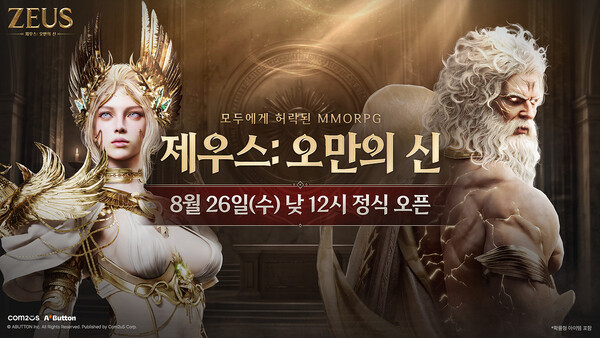
Com2uS, which is publishing the title, and Eiberton, which developed it, will launch service in South Korea for "Zeus: God of Pride" at noon on Aug. 26. Set in "Theia," a world that reconstructs Greek mythology, it is an MMORPG that features Unreal Engine 5-based graphics and competitive content.
What Zeus saw as the problem was not competition itself, but a structure in which competition concentrates on top users and reduces participation by many users. Instead of removing competition, it split content so users can participate in different ways depending on growth level and tendencies.
A representative piece of content is the seasonal "Odysseia," which spans PvE and PvP from individual play to guild units. In the 1-on-1 content "Colosseum," users can fight an AI entity called a "Persona" that reflects a player's appearance and combat ability, allowing them to compete at a desired time even if an opponent is not logged in.
For users who want direct competition, it set aside separate content such as field bosses, inter-server battlefields, and occupation battles, fortress battles and siege battles. It offers both direct and indirect competition so users can choose based on their growth stage and tendencies.
It also allows users to find roles outside competition. Four base classes expand to eight through job changes, and among them, "Artisan" is an economy class specialized in crafting and trading instead of combat. The structure allows growth through production and trade as well as fighting.
At a showcase held on Aug. 7, Eiberton CEO Dae-hwan Kim (김대훤) said, "We designed it broadly across individuals and guilds, and direct and indirect competition, so the meaning of competition does not concentrate on only some users." He added, "We will present an MMORPG where players can find roles and achievements in their own ways."
Ultimately, Zeus chose to expand the entry points to competition rather than weaken competition. It keeps direct competition for top users while widening options for users who feel burdened by competition to take part.
Eclipse: "So you do not have to fit your life around the game"; it starts by cutting login burdens
The approach is different for "Eclipse: The Awakening," developed by NPIXEL and published by Smilegate. It is being developed as a PC-mobile cross-platform title and presents "MMOLite" as its core direction, aiming to keep MMORPG depth while lowering play burden.
The starting point is time. Because MMORPG growth accumulates over a long period, gaps can easily widen if users do not log in. To reduce the burden of feeling that "you fall behind if you do not log in," Eclipse built a structure in which growth continues even when users are not logged in.
In its core content, the "Sanctuary," summon tickets, experience points and growth resources are automatically produced over time, and rewards accumulate even when users are not logged in and can be claimed at once upon return. As the sanctuary grows, production efficiency and combat ability also rise. It also adds 24-hour offline AI play so hunting and growth continue in a set manner after users exit the game.
It also reduced the burden of having to log in at a fixed time. Unlike general hot-time periods set by the system, "Eclipse Time" is content that users can activate at their desired moment to increase farming efficiency. For PvP, most areas are kept as safe zones, and only users seeking higher rewards can choose PvP zones.
NPIXEL executive producer Sang-moon Lee (이상문) said, "We thought it was important to provide an experience where it is not the user who adjusts their life to the game schedule, but the game operates naturally to fit the user's life pattern." On the payment structure, Smilegate director Jae-ik Shin (신재익) explained, "Payments should not be a necessity for growth, but an element users can choose depending on their play style."
Ultimately, Eclipse focuses less on reducing MMORPG play time than on easing the structure that requires users to spend time to fit the game.
If Zeus revised how players take part in competition, Eclipse directly targeted the structure that makes users adjust their time to the game.
Dokkaebi's World removes jobs and field PK, reducing a "set path"
Kakao Games, which is publishing the title, and Supercat, which developed it, aim to release "Dokkaebi's World" in October. Based on the Naver web novel and webtoon IP "Myeolgwi Sudujeon," it features a setting that incorporates Korean traditional folklore and 2.5D graphics that combine 2D dot characters with 3D backgrounds.
It also differentiates play style. The biggest change is that there are no "jobs." Instead of fixed classes, users combine 12 skill styles and about 90 types of skills to create their own combat style. Roles are not fixed to a job, and users switch skills depending on content and situations.
It also removed field PK. This is to encourage cooperation rather than conflict between users. Field bosses are also designed so rewards increase as the number of participants rises, rather than being monopolized by a few, placing weight on a faction-centered cooperation structure.
There is also a mechanism to reduce login burden. In some faction PvE content, a party can bring an AI version of a faction member's character who is not logged in, reducing the constraint that everyone must be logged in at the same time.
At a media showcase held on Aug. 20, Supercat director Soo-min Jang (장수민) said, "The difference between Dokkaebi's World and other MMORPGs is that there is no PK within the server." He added, "Within the same server, we actively encourage cooperation, and with no jobs, you can express your own individuality with skills alone, which is a distinctive differentiator."
Kakao Games co-CEO Si-woo Lee (이시우) said, "I believe Dokkaebi's World, which captures Korean sentiment and the fun of MMORPGs with a modern sensibility, will be a title that works not only in Korea but also in the global market."
Its visual differentiators are also clear. Unlike Zeus, which features Greek mythology, and Eclipse, which has an original setting, Dokkaebi's World uses Korean 소재 such as Korean folktales and hanbok. It also differentiated its screen composition with 2.5D dot graphics.
Dokkaebi's World is characterized by removing familiar structures in existing MMORPGs, such as jobs and PK, and widening user choice through skill selection and cooperation.
Kakao Games plans to hold an online showcase for users in September to disclose more details on content and service plans, and is preparing for an official release in October.
The burdens the three games aim to reduce differ. Zeus revised how users participate in competition, Eclipse targeted login time and play schedules, and Dokkaebi's World adjusted familiar MMORPG play structures such as jobs and PK.
What they share is an effort to reduce burdens that arise in maintaining the core of MMORPGs, namely long-term growth and interaction among users, without removing them.
An industry official said, "Recent new MMORPG titles are trying to change in a direction that reduces the points where users feel burdened, rather than removing the genre's core fun." The official added, "In the end, success or failure will likely be determined by how widely they expand the range of choices for users while keeping the fun of growth and competition."
 Hojeong Lee
lhj@d-today.co.kr
Hojeong Lee
lhj@d-today.co.kr