
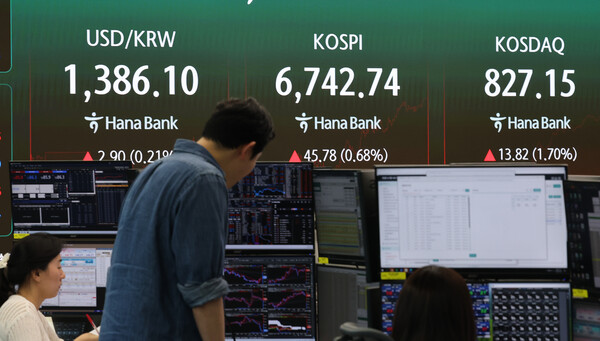
KOSPI rebounded after a one-day fall, supported by buying from individuals and institutions despite foreigners' net selling of about 3.8 trillion won. The index, which had slid into the 6,400 range during the session, erased all losses in the afternoon. The Kosdaq maintained a relatively strong run, rising more than 1 percent.
On Aug. 25, the KOSPI ended up 45.78 points, or 0.68 percent, at 6,742.74. It opened down 161.03 points, or 2.40 percent, at 6,535.93 and fell into the 6,400 range during the session. It later turned higher as bargain hunting emerged and rose as high as 6,747.16 late in the session.
In the main bourse, foreigners posted net selling of 3.8152 trillion won. Individuals and institutions recorded net buying of 1.0503 trillion won and 1.1728 trillion won, respectively.
Chip shares, which had been shaken by Samsung Electronics' sharp fall the previous day, found some stability. Samsung Electronics ended flat at 257,000 won, while SK Hynix rose 0.42 percent to 1,678,000 won.
Samsung Electro-Mechanics rose 3.34 percent to 1,362,000 won, and Hyundai Motor gained 1.69 percent to close at 421,000 won. Samsung Biologics and KB Financial also rose 0.76 percent and 2.02 percent, respectively.
In contrast, SK Square fell 1.49 percent to 1,060,000 won, and LG Energy Solution slid 3.45 percent to 349,500 won.
The Kosdaq posted a stronger rise than the KOSPI. It closed up 13.82 points, or 1.70 percent, at 827.15.
In Seoul's foreign exchange market, the won-dollar exchange rate rose 2.30 won from the previous session to 1,386.30 won.
With volatility rising around large chip stocks recently, a sector-rotation flow appears to be continuing as funds move into small- and mid-cap shares and non-chip sectors that had seen relatively larger declines.
U.S. stocks were mixed the previous day as chip-share adjustments weighed. The Dow Jones index rose 0.26 percent, while the Standard & Poor's 500 fell 0.28 percent and the Nasdaq slipped 0.76 percent. The Philadelphia Semiconductor Index fell 2.70 percent. Nvidia dropped 2.91 percent and Micron fell 5.83 percent.
Kiwoom Securities analyst Ji-young Han (한지영) said recent weakness in chip stocks was a short-term factor created by a pullback in expectations for shareholder returns rather than a crack in fundamentals, and by supply-demand volatility ahead of caution over Nvidia earnings. Han said, given the broadening of gains across sectors and easing concentration in a few industries, there is a need to put weight on the continuity of the rebound.
 Sangyeop Oh
yub@d-today.co.kr
Sangyeop Oh
yub@d-today.co.kr