
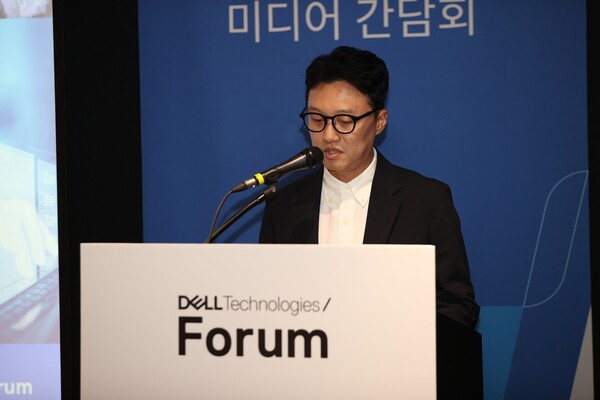
"As agentic AI spreads, the stage for AI computing is expanding beyond the cloud to PCs on employees' desks."
Jae-wook Jung (정재욱), director of field product marketing at Dell Technologies Korea, repeatedly stressed at a press briefing held on the sidelines of the 'Dell Technologies Forum 2026' that the spread of agentic AI will be a catalyst that increases the weight of PCs in corporate AI infrastructure.
"Agents judge on their own, call each other and execute without rest. Reasoning happens continuously within day-to-day work flows. This kind of reasoning work needs to be done right where data is created," he said, highlighting that the AI environment is evolving in a direction that increasingly requires AI PCs.
Jung presented three main trends related to AI infrastructure at the briefing.
They were that AI workloads are expanding beyond the cloud to on-premise data centres and AI PCs and workstations on users' desks, that AI PCs have moved into a core position in AI-native organisations, and that as AI moves down to endpoints the attack surface broadens and the importance of data management and security also increases.
On security, Jung cited external research results that 61 percent of attacks are related to direct compromise of enterprise devices and said, "Dell is responding by checking security across the entire process of product design, development and testing."
Jung also addressed token cost issues in connection with AI PCs. "Token unit prices are falling, but as total usage surges the actual billed amount is instead increasing. AI tokens have now become one of the line items on the profit-and-loss statement, and there is no need to rent all tokens from the cloud. If you process them directly where work actually happens, on employees' PCs, you can reduce costs," he said.
A hybrid AI deployment strategy is also a point Jung emphasises.
The cloud is suitable for sudden surges in demand or large-scale training. Data centres handle internal data owned by companies or key workloads. Desktops are optimised for handling repetitive tasks and sensitive data locally. "The core of a hybrid AI deployment strategy is to combine the three environments according to workload characteristics," Jung said. He added, "To convert AI potential into tangible results, the work environment itself needs to be prepared to adopt AI," and said, "Dell Pro AI PCs are AI infrastructure centred on the employee experience."
The Dell Technologies Forum event followed welcoming remarks by Kyung-jin Kim (김경진), chairman of Dell Technologies Korea, and included keynote speeches by Sang-mo Yoo (유상모), president, and Matt Dunfee, senior vice president at the company's headquarters. Yoo and Dunfee stressed that "now is the time to create tangible business results through AI."
Yoo cited results from a recent research report, 'The Modern Enterprise Readiness Study 2026', and said 87 percent of responding companies are having difficulty responding to a rapidly changing environment, while 66 percent said it is difficult to predict how their industry will change in 3 to 5 years, diagnosing that they face uncertainty and disruptive change.
Dunfee named three essential tasks to overcome this: modernising data centres, scaling AI based on safety and trust, and implementing a modern work environment. He highlighted findings that 72 percent of domestic companies that participated in the survey said their current data centre environments are not sufficient to support large-scale AI and analytics workloads, and reported that 84 percent of respondents appear to have data centre modernisation plans to reduce infrastructure complexity by consolidating and transitioning multiple pieces of old equipment to the latest servers and storage.
 Chi-gyu Hwang
delight@d-today.co.kr
Chi-gyu Hwang
delight@d-today.co.kr