
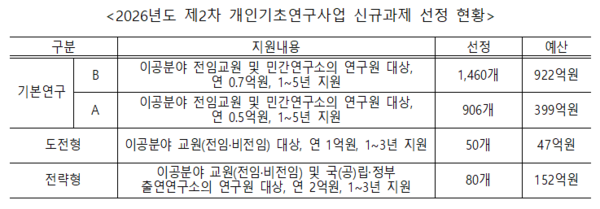
The government will provide 152 billion won to 2,496 individual basic research projects to expand entry and growth opportunities for early-career researchers.
The Ministry of Science and ICT said on Monday it selected 2,496 projects, including basic research, challenge-type research and strategic-type research, after the second 2026 call and evaluation process. It said support will begin on Sept. 1.
By category, basic research accounts for the largest share, with 2,366 projects. It will provide 92.2 billion won for 1,460 Basic Research Type B projects and 39.9 billion won for 906 Type A projects. It will invest 4.7 billion won in 50 challenge-type research projects and 15.2 billion won in 80 strategic-type research projects.
The basic research program offers small-scale, long-term research opportunities to a range of researchers, including early-career faculty members and researchers based outside the capital region, to broaden the foundation of the basic research ecosystem. It was abolished in 2024 but was restored and expanded this year. Average funding per project is 55.86 million won, about 10 percent higher than 50.91 million won in 2023, before the program was abolished. The support period was also extended to a maximum of 5 years from the previous maximum of 3 years.
Selected basic research projects include a study by Suk-young Woo (우숙영), a professor in the AI Software Department at Daejeon University, on developing a methodology to determine optimal cut-off values that reflect nonlinear risk structures in competitive-risk survival data. The aim is to strengthen the scientific basis for medical decision-making.
Challenge-type research supports studies aimed at discovering and establishing new concepts. It applied an exception to the principle of one project per individual researcher to enable linkage with existing or future projects. The ministry said it first screened proposals based on preliminary plans that reflect originality and innovation, then selected 50 projects through a full evaluation. A study by Jae-taek Kim (김재택), a professor at Chung-Ang University College of Medicine, on identifying the metabolic landscape and substrate dependence of the sinoatrial node was selected as a challenge-type research project.
Strategic-type research supports basic research that responds to national and social demand, including national strategic technologies and future promising fields. It selected 80 projects in areas including AI, semiconductors, robots, genes and infectious diseases. Jong-min Lee (이종민), a professor in the Division of Advanced Computing at Yonsei University, will conduct research on core technology for learning general-purpose decision-making AI foundation policies that can adapt immediately without large-scale retraining.
Sung-soo Kim (김성수), director general for R&D Policy at the ministry, said, "The diversity of basic research is the start of pioneering new research fields and expanding convergent and interdisciplinary research." He said, "We will continue to support efforts to strengthen the challenge and innovation of basic research while expanding entry and growth opportunities for early-career researchers."
 Jin-ho Lee
jhlee26@d-today.co.kr
Jin-ho Lee
jhlee26@d-today.co.kr