
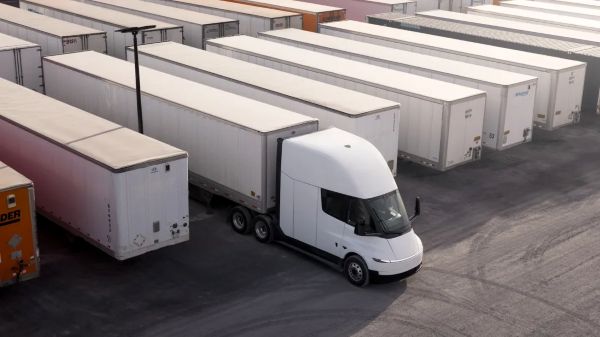
[DigitalToday reporter Jinju Hong (홍진주)] Tesla will hold a completion ceremony next month for a dedicated factory for its electric truck Semi in Nevada. With vehicle production having already started months ago, the event is expected to be symbolic, signaling the Semi business entering a full-scale mass production phase rather than marking the start of production.
On Aug. 25 (local time), electric vehicle outlet Electrek reported that Tesla plans to hold an official opening event for the new Semi factory in Nevada on Sept. 24.
Tesla announced through a dedicated Semi account that it will hold the completion ceremony next month for the new Semi plant in Nevada. Images released along with the announcement are titled "Semi Rollout."
The event does not mean production is starting. Tesla has said it shipped the first vehicle from the plant's high-speed production line in April and that mass production of the Semi began about 5 months ago.
The new plant is located in Sparks, Nevada, and was built near the existing Gigafactory Nevada. It is part of Tesla's $3.6 billion factory expansion plan announced in early 2023. The dedicated Semi plant covers about 1.7 million square feet and aims to have a designed capacity of up to 50,000 vehicles a year. Tesla also began hiring related personnel in early 2025 to expand production.
Tesla is also pursuing a vertical integration strategy by linking the adjacent Gigafactory Nevada and the Semi plant to consolidate key manufacturing processes in one location. It aims to streamline parts procurement and manufacturing and secure a foundation for mass production.
The mass production model of the Semi is divided into Standard Range and Long Range versions depending on driving range. The Standard Range targets 325 miles and the Long Range targets 500 miles.
Both models use an 800-kilowatt-class three-motor powertrain with output of more than 1,000 horsepower. They also support Tesla's Megacharger charging infrastructure for heavy electric trucks, and the company explained that about 70 percent of the battery's driving range can be restored in about 30 minutes.
The market is focusing less on the opening ceremony itself than on how quickly actual production volumes will rise. The 50,000-a-year figure is the plant's maximum designed capacity and does not mean current output. Dan Priestley (댄 프리스틀리), a Tesla program director, also said in April that Semi production is currently expanding after the production line began operating.
Tesla has been producing vehicles for several months in the form of a pilot programme and delivering them to customer companies. The event therefore has meaning less as a first announcement of plant operations than as a message to the market that Tesla will expand the production it has been conducting into full-scale mass production.
The Semi took a considerable time to reach launch. When Tesla first unveiled the Semi in 2017, it targeted production in 2019, but the schedule was delayed multiple times. In 2022, it delivered hand-built production units to PepsiCo, and only this year began to build a full-scale mass production system. The completion ceremony is expected to serve as an occasion to highlight that the Semi has entered an actual mass production phase after these delays.
Tesla is also set to unveil its strategy for expanding the Semi at the IAA event in Europe next month. By holding the Nevada plant ceremony and the European event in succession, it is expected to raise market attention to the expansion of its electric truck business.
A key point to watch will be how quickly the company can turn the plant's designed capacity of 50,000 a year into actual output. Whether Tesla can substantially increase Semi deliveries beyond pilot production and early customer deliveries, and how many concrete figures it can present on operating costs and efficiency, are expected to be yardsticks for gauging the competitiveness of the Semi business.
 Jinju Hong (홍진주)
hongjj@d-today.co.kr
Jinju Hong (홍진주)
hongjj@d-today.co.kr