
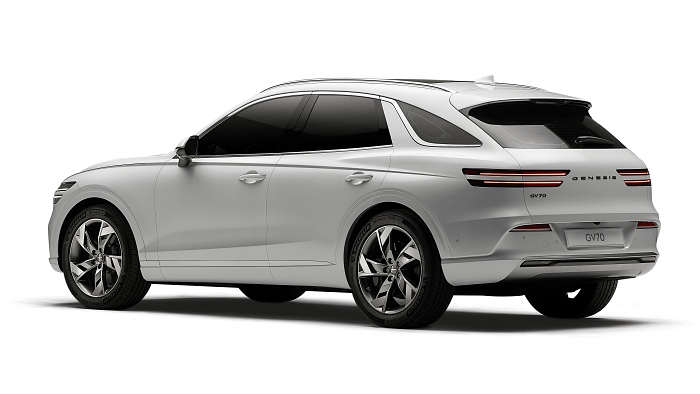
An Australian owner who has driven the electric Genesis GV70 for about 4 years has disclosed his real-world experience from 44,000 km. He shared driving data covering long-distance travel, efficiency, charging costs, maintenance and convenience features, showing a long-term ownership experience of a premium electric SUV.
CleanTechnica, an electric-vehicle outlet, reported on Aug. 24 that David Ball (데이비드 볼), who lives in Australia, bought the Genesis GV70 Electrified in 2023 and has driven about 44,000 km.
Ball said the biggest reasons for choosing an electric vehicle were driving range and cargo space. He also looked at hybrids while considering replacing his car, but said he did not want a vehicle with a greater maintenance burden than a battery electric vehicle. With frequent travel, he said having enough space for luggage and long-distance performance were also important.
He looked at the Tesla Model Y in person three times but said he did not like the glass roof, the seat material and the feel of wearing the seatbelt. He said the GV70 Electrified influenced his choice because it had an interior layout similar to internal combustion vehicles, with physical buttons and dials.
He said it also helped that before purchase, the dealer brought the vehicle to his home so he could load camping gear and travel luggage himself. Ball said he was able to load everything and expressed satisfaction with the buying experience.
The vehicle was not cheap. The GV70 Electrified that Ball bought cost A$138,000. The Tesla Model Y Long Range he considered for comparison was about A$103,000, and the BMW i4 was about A$114,000.
He said the initial purchase cost was burdensome but judged it was worth it over the long term. He said the 5 years of free concierge service also affected his decision. Regular inspections are conducted once a year, with the vehicle collected from his home, a loaner provided and the car returned afterward.
He said he was also highly satisfied on long-distance driving. Ball and his wife took two trips in the GV70 Electrified, each a 4,500 km round journey to Melbourne.
When he could use ultra-fast chargers, charging took about 10 to 20 minutes. He adjusted charging schedules to match meal breaks or driver changes. He said both the spread of charging infrastructure and charging speed have improved recently.
Efficiency varied depending on temperature and driving conditions. During the first long-distance trip, the temperature was about 30 degrees, but on the second trip the maximum temperature fell to 12 degrees. The long-term average power consumption on long-distance driving was about 23 kWh per 100 km. In everyday driving it was about 19 kWh, and the overall average across the full 44,000 km was calculated at 19.6 kWh. Ball said he operates the vehicle by recording travel time and costs and electricity use himself, and calculating the next charging point in advance.
A home solar power system played a big role in lowering charging costs. The total cost of fast charging for the two Melbourne round trips was about A$1,100. By contrast, the charging cost for the remaining roughly 36,000 km of driving was estimated at about A$410.
He said the home charger provided with the vehicle is installed in the center of his garage. Ball said he also uses the charger for another electric vehicle, the Kona Electric, and his home also has a rooftop solar system and a Tesla Powerwall.
He also assessed driving convenience features positively. He said the feature that automatically changes settings such as seats, steering wheel, side mirrors and radio based on the driver reduced setup time when sharing the vehicle.
He said one-pedal driving also became a feature he enjoys using after adapting to it. With frequent long-distance family travel, he also cited the massage seats, quietness and augmented reality-based navigation display as strengths.
Safety was also an important reason for choosing the vehicle. Ball, a former civil engineer, said he placed importance on safety, citing his past participation in road safety policy research. He assessed that the GV70 Electrified met required standards in both active and passive safety.
Environmental issues also lay behind his switch to an electric vehicle. Ball said he chose an EV to reduce dependence on fossil fuels. He gave his Mazda6 wagon to his children, and replaced a Kia Cerato GT with a Kona Electric. He said he expects the role of internal combustion vehicles to continue shrinking.
Sales of the GV70 Electrified in Australia are not large. Ball said he considers it an advantage that the vehicle is not easily noticeable on the road. He said it looks similar to the internal combustion GV70, making it hard to recognise as an EV except for the blocked-off front grille and the lack of an exhaust pipe.
Because sales are low, there are concerns that sourcing body parts could be disadvantageous in the event of an accident. Ball said the similar design to the existing GV70 could instead be an advantage for parts.
This case of driving 44,000 km over about 4 years shows what a premium electric SUV can offer in real long-distance travel and a home-charging environment. The overall average efficiency of 19.6 kWh and a charging setup using home solar power were assessed as showing the need to consider not only the initial purchase price of an EV but also long-term operating costs.
 Jinju Hong
hongjj@d-today.co.kr
Jinju Hong
hongjj@d-today.co.kr