
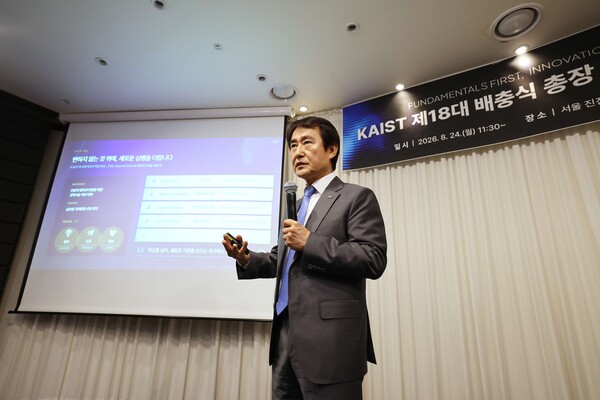
Bae Chung-sik (배충식), the new president of the Korea Advanced Institute of Science and Technology (KAIST), is launching an initiative to build an "AI campus". KAIST will introduce a system for using AI across all courses and provide entrepreneurship education starting with freshmen. It will also overhaul university operations from education to research and administration by expanding company-backed "AI autonomous labs".
Bae held an inaugural press briefing on Aug. 24 and unveiled action plans to realise the vision of a "global innovation-leading university with strong fundamentals".
At his inauguration ceremony on Aug. 10, Bae presented five development strategies: AI for all (Beyond AI); innovative research and startups (Beyond Laboratory); an efficient and open university (Beyond Barrier); eco-friendliness and sustainability (Beyond Carbon); and to the world, to the future (Beyond KAIST).
The ultimate goal is to build an "AI campus" that links education, research, administration and infrastructure into one system. Bae said on the day, "If the vision presented at the time of my inauguration was the direction KAIST should go, now is the time to turn it into changes that members can feel." He said he would 추진 tasks that can be executed at speed.
◆ AI use across all courses... building an AI-native campus
Under Beyond AI, KAIST will expand AI from a technology for a specific department or major to a common capability that all students and researchers must have. It will strengthen basic education including mathematics and natural sciences and the humanities, social sciences and arts, while building a curriculum that strengthens AI applications in each major.
KAIST will divide the curriculum into three stages based on the level of AI use and establish an AI use framework for all courses. The goal is to assign an AI use grade to each course and systematise it into self-reliant, expansion and leading areas. Bae said, "A complete transformation of the lecture system must be achieved." He said education in the humanities and social sciences and in basic sciences would aim to be self-reliant, with students writing, thinking and presenting with professors rather than relying on AI.
Under Beyond Laboratory, KAIST will expand physical AI research, including AI core technologies and sovereign AI, as well as autonomous driving, smart factories, robotics and digital twins. It will also strengthen convergent research that combines AI with energy, quantum, nuclear fusion and bio. Bae said he would work to conduct research with industry to lead national strategic technologies and future technologies.
To that end, KAIST will prepare an education model that can build entrepreneurship and startup capabilities starting from the first semester of the first year. It will form a Startup Education Innovation Committee and build "AI autonomous labs" with companies. AI autonomous labs aim to boost research and development speed and productivity by using AI and automation to streamline research processes such as experiment design and execution and data analysis.
Bae said, "Labs must become the starting point of innovation that creates changes in industry and society." He said the university would, from admission, provide entrepreneurship education so students can develop the ability to connect ideas and technology to social value. KAIST is currently 추진 measures such as recognising startup activities for academic credit and allowing startup practicum reports to replace undergraduate thesis requirements.
◆ Removing administrative barriers... launching a one-stop administrative system
The university will also revamp administration so professors and students can focus on education and research. This is the Beyond Barrier strategy to eliminate administrative barriers. KAIST will build an AI-based digital one-stop administrative system to automate repetitive tasks and simplify administrative procedures. It will improve unnecessary internal regulations and provide incentives to staff who participate in AI-based administrative innovation.
It will also revise systems that hinder interdisciplinary convergence, such as lowering course barriers between departments and expanding joint supervisor arrangements. It will simplify unnecessary personnel procedures as much as possible, such as requiring an excessive amount of paperwork in promotion reviews. This was Bae's account that the university will create evaluation standards tailored to each area to conduct efficient personnel management.
Bae said, "The purpose of administration is not management itself, but to help students and professors immerse themselves more in education and research." He said he would actively identify and improve regulations and procedures that take away members' time.
◆ Promoting a sustainable campus... bringing global talent to KAIST
In climate and energy, KAIST will apply technologies it has developed directly to the campus. It will use AI and energy technologies to manage campus energy use efficiently. It will pursue spatial innovation that considers safety, convenience and protection of green spaces, including improving routes to prioritise pedestrians and rearranging research and education spaces more efficiently.
Its internationalisation strategy will expand toward drawing overseas talent and research institutions to KAIST. Beyond simple overseas exchanges, it will create an environment where outstanding foreign talent and research institutions gather at KAIST. It will sharply raise the proportion of excellent foreign students and increase dual degrees, exchange students and researcher exchanges with overseas universities.
It will increase participation by overseas scholars in thesis evaluations and operate global advisory groups by academic and research organisations. It will also strengthen incentives for international joint research. Domestically, it will link research complexes and regions, including the Daedeok research and development special zone, into a strategic-technology-centered cluster. It also plans to 추진 "KAIST Connect," involving students, professors, staff and alumni.
KAIST will link these tasks to a mid- to long-term development strategy toward the university's 60th anniversary in 2031. Bae, whose term runs through 2030, stressed he would focus all efforts on laying the groundwork to prepare for the 60th anniversary.
Bae said, "KAIST's goal is not to follow the world's best universities, but to create a new standard for universities." He stressed that KAIST would create new models in education and research in the AI era, technology startups, university operations, a sustainable campus and global cooperation, and spread them to South Korea and the world.
 Jin-ho Lee
jhlee26@d-today.co.kr
Jin-ho Lee
jhlee26@d-today.co.kr