
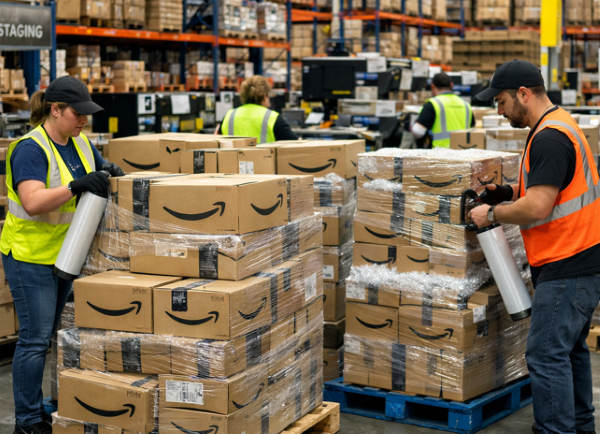
Amazon is pursuing a new project called Tetromino aimed at fully automating delivery stations, logistics hubs just before delivery.
Business Insider reported on Aug. 24 that Amazon is internally reviewing ways to use artificial intelligence and robots to automate package sorting and vehicle loading. Amazon said Tetromino is still an early-stage concept and that specific financial figures and timelines in related documents do not reflect current plans.
A delivery station is the final logistics hub where packages are sorted and loaded onto delivery vehicles after being handed over from a fulfilment centre, before reaching customers. Internal planning documents included a plan to raise processing speed at Tetromino-equipped delivery stations by about 2.5 times compared with existing designs.
The documents included a plan to invest $103 million in a Tetromino pilot in 2028 and expand to 5 hubs in 2029 and 10 hubs in 2030. The estimated build-out cost per hub in 2029 was about $85 million. Based on the documents, cumulative investment could exceed $530 million by 2029.
Amazon said those figures and timelines do not reflect current plans. An Amazon spokesperson described Tetromino as an "early-stage concept" and said specific financial figures and the roadmap were inaccurate. Amazon said it is testing various technologies to improve safety and the customer delivery experience, and that early concepts can change significantly during validation.
Tetromino ties into Amazon's broader push to expand logistics automation. Amazon said in its July earnings release that it expects to more than double the scale of its robotic arms in 2026. It is also introducing software that automatically recommends staff allocation in line with changes in workloads at logistics sites.
The documents said one of the core technologies mentioned was a system from logistics automation startup Boxbot. The system stores packages by moving them from a conveyor to trays, then uses AI to retrieve them and arrange them according to the delivery sequence. Boxbot says its technology can make vehicle loading up to 10 times faster. It was not confirmed whether Boxbot will participate in the Tetromino project.
Automation is also expanding across the logistics industry. FedEx is expanding trailer-loading automation using robots from Dexterity, and UPS and DHL are also introducing robots for unloading work. Amazon also announced a delivery-station automation pilot that includes package unloading, sorting and scanning equipment, as it invested 700 million euros in European facilities last year.
The workforce impact of wider automation is also drawing attention. Tye Brady (타이 브래디), head of Amazon Robotics, said the goal is to make on-site work safer and more efficient rather than replace employees. Amazon also says delivery-station automation is intended to complement staffing.
Ultimately, the core of Tetromino is not only about speeding up processing at delivery stations. The key issue is whether AI and robots can automate even the last logistics stretch, where packages vary in size and shape and where delivery sequence and vehicle loading space constantly change. Attention is focused on whether Amazon can implement such automation in real operating environments.
 Seung-a Yoo
ysah@d-today.co.kr
Seung-a Yoo
ysah@d-today.co.kr