
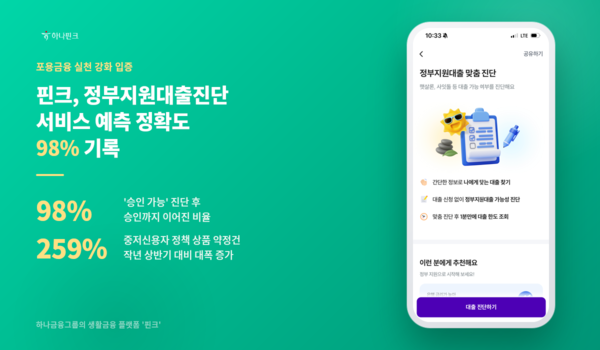
Hana Financial Group’s lifestyle finance platform Finnq is moving to practice inclusive finance with a service that checks the availability of policy finance products for ordinary people, such as Haetsal Loan and Saetdol.
Finnq said on Aug. 25 it is improving access to policy finance for middle- and low-credit borrowers through its government-backed loan assessment service.
The service checks the likelihood of approval for policy loan products for middle- and low-credit borrowers, including Haetsal Loan and Saetdol.
Finnq said 98 percent of customers who received an “approval possible” assessment were actually approved for loans.
An analysis of users showed Haetsal Loan special guarantee users had an average annual income of 27 million won and an average credit score of 572. Haetsal Loan general guarantee users had an average annual income of 30 million won and an average credit score of 593.
New Hope Seed users had an average annual income of 23.8 million won and an average credit score of 618. Saetdol users were found to have an average annual income of 60 million won and an average credit score of 608.
By occupation, other jobs accounted for the largest share at 43 percent, followed by office workers at 41 percent, self-employed people at 8 percent, homemakers at 7 percent and civil servants at 1 percent.
An analysis of loan data brokered through the app showed the number of policy-support loan contracts for middle- and low-credit borrowers with credit scores of 700 or lower rose 259 percent from the first half of last year.
Jang Il-ho (장일호), Finnq’s chief executive, said, “Government-backed loan products have varying conditions by institution, making it cumbersome to check eligibility one by one, but the assessment service now makes it possible to do everything at once, from checking qualifications to applying for a loan.”
 Ji-young Lee
ljy@d-today.co.kr
Ji-young Lee
ljy@d-today.co.kr