
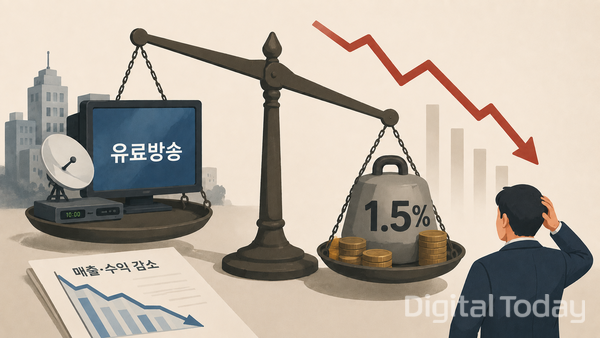
The cable TV industry’s long-running call to ease its burden from the Broadcasting and Communications Development Fund has effectively failed again this year. The Broadcast Media Communications Commission plans to issue fund bills later this month using the current collection rate. The industry says a cut that had been discussed to the point of a conclusion at the Ministry of Science and ICT returned to square one during the creation of a new ministry and the transfer of duties.
According to the commission and the pay-TV industry on Aug. 25, the commission plans to issue 2026 fund contribution bills to broadcasters as early as later this month. The pay-TV contribution is calculated based on the previous year’s broadcasting service revenue and is imposed under the current notice without a separate commission resolution.
As a result, pay-TV operators such as system operators (SO) will again face the current collection rate this year of 1.5 percent of broadcasting service revenue.
A commission official said the bills will be issued around the end of August and there will be no separate commission resolution.
The industry believes discussions on cutting the fund levy made significant progress at the Ministry of Science and ICT, the previous competent ministry, but were put back under review after the commission was created and duties were transferred. The ministry is known to have reviewed, to the level of a conclusion, a plan to lower the SO collection rate to 1.3 percent from 1.5 percent.
The industry believes it will again be subject to the current rate this year because institutional improvements pursued to reflect industry conditions were delayed during the government reorganisation process.
The cable TV industry says it is pushing for a lower rate because profitability has deteriorated sharply. The fund is imposed based on broadcasting service revenue regardless of operators’ profit and loss, and SO profitability has fallen steeply due to declining subscribers and a shrinking advertising market.
SO broadcasting business revenue fell 25.3 percent to 1.68 trillion won in 2024 from 2.26 trillion won in 2015. Operating profit over the same period plunged 96.3 percent to 14.9 billion won from 405.2 billion won. By contrast, the fund paid in 2024 by 90 SO companies was about 25.0 billion won, equivalent to 168 percent of total operating profit.
Loss-making operators also pay the contribution. In 2024, 38 SO companies that posted operating losses recorded a combined loss of 117.8 billion won but paid about 9.5 billion won to the fund. No separate reduction rules based on business conditions apply to SOs.
The industry is also raising a fairness issue with other broadcasters. Terrestrial broadcasters and general programming channels and news channels calculate the fund based on advertising revenue and can receive reductions depending on business conditions, but SOs have no such reduction system.
The commission, however, says that while it acknowledges the cable TV industry’s management difficulties, it should review the fund burden structure for the entire broadcasting market rather than adjusting the rate only for specific operators.
A commission official said the commission is aware the cable TV industry is struggling but it is not an issue that can be viewed only through cable. The official said broadcasters are also experiencing difficulties, including declining advertising revenue, and the overall market situation should be reviewed comprehensively.
The official added that the commission heard about the difficulties at meetings with the cable TV industry, but at that time there was not enough time to comprehensively review the entire market and reflect changes immediately this year. The official added the commission has consistently explained its position that it will examine the overall collection system.
The commission is conducting a study through the Korea Communications Agency (KCA) titled "Research on improving the Broadcasting and Communications Development Fund contribution system and diversifying revenue". It mainly reviews an integrated system for imposing and collecting broadcaster contributions in line with the commission’s launch and redesigns the assessment standards and collection rates by business category.
The pay-TV industry says that separate from a long-term system overhaul, immediate measures to ease the burden must come first. It is also considering filing a lawsuit seeking cancellation against the commission’s imposition decision after bills are issued this month.
An industry official said it is necessary to take a comprehensive look at the entire broadcasting market, but the government should take measures that are immediately needed rather than treating it as a distant issue. The official said the industry is also reviewing a plan to file an administrative lawsuit over the current method of imposing the fund.
 Seul-gi Son (손슬기)
sageson@d-today.co.kr
Seul-gi Son (손슬기)
sageson@d-today.co.kr