
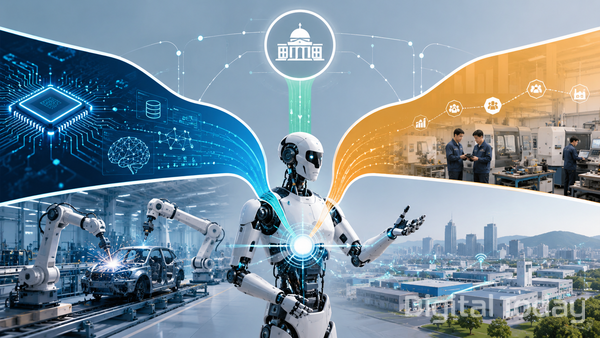
As physical AI expands into the real world through robots, industrial equipment, cameras and autonomous mobile robots, Amazon Web Services (AWS) is moving to build an operating system that links the cloud and the edge. SiliconANGLE reported on Aug. 24 that AWS last month unveiled a cloud-edge integrated solution for customers developing physical AI systems.
Physical AI refers to AI that goes beyond content generation or data analysis to perceive and judge a physical environment and then carry out real actions. Existing industrial automation and robotics were strong at repetitive tasks in fixed environments. Physical AI is evolving toward sensing surrounding conditions, learning from experience and responding to change.
AWS cited data and simulation, latency and post-deployment operations as the biggest challenges facing physical AI. Robots need to learn from data that reflects physical conditions such as objects and surfaces, lighting, geometry, friction, hand position and contact force, rather than text and code.
AWS partner Config has built more than 200,000 hours of robot behavior data and is collecting about 20,000 hours more each month. AWS and Config established a multi-view augmentation pipeline that reconstructs real demonstration data under various lighting and surface conditions using Nvidia Cosmos-Transfer2.5 post-training models. Config said the success rate rose to 75 percent from 8.3 percent after adding augmented data.
Simulation is also cited as one of the tasks physical AI must solve. Learning directly in real environments is slow and costly and raises safety issues.
AWS is enabling customers to use their own simulation tools or Nvidia Isaac Sim. It is also providing cloud infrastructure and data services that allow simulation environments to be scaled up or down as needed.
At the deployment stage, dividing roles between the cloud and the edge is important. SiliconANGLE reported that large foundation models are trained in the cloud, but robots moving through hospital corridors or equipment inspecting production lines cannot easily wait for remote cloud responses. AWS explained that it is important to feed on-site learning results back to the cloud to improve overall performance.
AWS is approaching the market not as a robot maker but as a provider of a physical AI operations stack. For training, it provides Amazon EC2 GPU instances, Amazon SageMaker, Amazon S3 and Amazon FSx for Lustre. For deployment, it supports connectivity, device fleet management and edge runtime environments through AWS IoT Core and AWS IoT Greengrass. It is also pushing to automate environment setup, training workflows, simulation settings and troubleshooting as a development environment.
 Chi-gyu Hwang
delight@d-today.co.kr
Chi-gyu Hwang
delight@d-today.co.kr