
Naver and Kakao have been put to a new test of labor relations as they operate multiple affiliates and reshuffle their governance structures. Critics say the head office and group wield significant influence over key decisions such as personnel, budgets, investment and reorganisations. That is fuelling debate over whether the existing company-by-company bargaining model matches the actual management structure.
On Aug. 24, the industry said Naver received a demand from its union on Aug. 20 for unified bargaining that would combine 16 entities into one. Kakao will also receive a demand on Aug. 26 for joint bargaining covering major affiliates.
Kakao in particular announced a corporate split on Aug. 21 that will divide the company into KakaoAI and KakaoX. As it reorganises its structure to improve efficiency in business and capital allocation, labour is demanding a separate bargaining structure covering affiliates. That has emerged as a new task for Kakao over how to divide subsidiary independence and responsibility at the community level.
Naver: individual bargaining structure for 16 affiliates put to the test
Naver operates a range of services and businesses by dividing them among multiple affiliates centred on the head office. About 6,200 union members from the head office and 28 affiliates and related entities are currently enrolled in Naver’s union. Individual bargaining is under way at 16 entities.
The issue is that while each entity is independent, critics say Naver’s head office has strong influence in key decision-making processes.
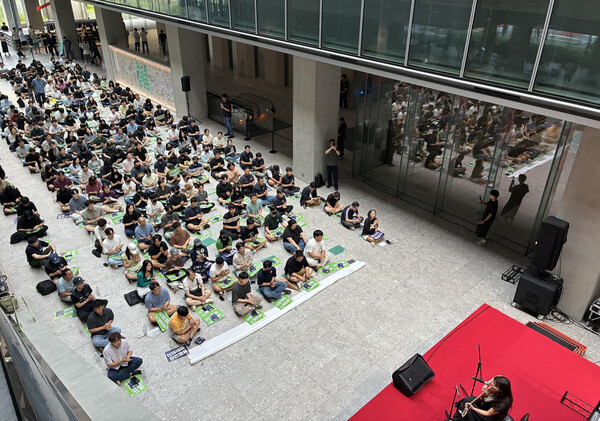
At an event titled the 2026 unified bargaining kickoff held on Aug. 20 at Naver’s 1784 building in Seongnam, Gyeonggi province, the Naver branch formally demanded unified bargaining from Naver’s head office for the 16 entities. The proposal calls for one-time talks with the head office on shared issues, including improvements to companywide integrated management processes, the work environment, safety and health, welfare and integrated labor-management relations.
The union said about 150 bargaining sessions were held across the 16 entities over the past year, taking about 1,000 hours. It said similar negotiations are being repeated because while talks are conducted at individual entities, the head office’s judgment influences the final agreement process.
Oh Se-yoon (오세윤), head of the Naver branch, said, "Bargaining was separate, but talks moved only when Naver decided." He said, "It is about aligning the structure that actually decides with the structure that bargains."
Naver Z, where recent wage negotiations broke down, is a case in which conflict over that structure has surfaced.
Naver Z labor and management entered wage talks on Feb. 26, but negotiations broke down as the company stuck to a 0 percent increase, citing worsening management conditions. Naver Z has not posted a profit since its establishment in 2020 and, as of the end of 2025, has been in capital impairment for six consecutive years. Two mediation efforts by the labor relations commission were also both halted, and the union secured the right to strike with a turnout of 88.6 percent and approval of 98 percent in a strike ballot. The union plans to designate Sept. 9 as a "Z action day" and take action if there is no responsible response from the company by the end of August.
The union is taking issue with Naver investing 130 billion won in a paid-in capital increase at Kream while citing individual entities’ management conditions over the Naver Z wage issue.
Others counter that because each affiliate has a different business structure and performance, it is difficult for Naver’s head office to uniformly determine working conditions for all companies. If the unified bargaining demand is accepted, it will also be a task to resolve how far the head office will participate in labor-management relations at affiliates.
Kakao pursues corporate split, community labor relations also a variable
Kakao faces a different set of tasks from Naver.
Kakao announced on Aug. 21 a governance restructuring plan to split the existing company into KakaoAI and KakaoX. Enhancing corporate value and improving the efficiency of decision-making and capital allocation are the main objectives of the split presented by the company.
As the company structure is divided again, questions have also emerged over at what level to discuss employment, reorganisations and workforce movement among affiliates.
The Kakao branch had already said on Aug. 19, ahead of the split announcement, that it would push for joint bargaining involving major affiliates by the end of August. On Aug. 26 it will hold a ceremony in Pangyo Station Plaza to declare joint bargaining across the Kakao community, alongside a rally to resolve a fifth consecutive day of strikes at KakaoBank.
Kakao’s joint bargaining differs in structure from Naver’s unified bargaining. Kakao would keep the existing entity-by-entity bargaining while discussing only issues that commonly affect multiple companies in a separate joint bargaining forum. It seeks to maintain the independence of management at each entity while creating a separate consultation structure for matters decided at the community level.
The Kakao branch presented agenda items for joint bargaining including responsible management, employment stability and fair performance distribution, as well as prior consultation during reorganisations, sales and spinoffs, reassignments within the community, and community-level safety nets for employment and welfare.
It said that if restructuring or sales, mergers, spinoffs or business transfers occur after the split, it needs to discuss with the company how to protect employment and working conditions. The Kakao branch is demanding that before an extraordinary general meeting of shareholders in December, the company disclose the impact the split will have on employment and working conditions at Kakao and major affiliates and begin consultations.
How far does group responsibility go while maintaining entity-level independence
Naver and Kakao are in different situations, but the questions they face from a management perspective are similar.
Both companies have operated multiple entities and affiliates during their growth to enhance business-specific expertise. Each entity is an independent company with its own board, management and financial structure. Because performance and workforce structures differ, it is difficult to apply all conditions, including wages and personnel, uniformly at the group level.
At the same time, there are areas where a head office or group judgment affects multiple entities at once, such as workforce movement among affiliates, common welfare and work systems, and large-scale investment and business restructuring.
Ultimately, the issue Naver and Kakao must sort out is how far the head office or the community will be responsible for labor-management relations while maintaining the current management structure of operating entities separately.
Naver’s union is seeking unified bargaining that would combine collective agreement negotiations that have been conducted by entity. Kakao’s union wants to keep entity-level bargaining and add joint bargaining to cover common agenda items. Both approaches require new standards, from a corporate perspective, on how far to divide authority and responsibility between the head office and affiliates.
Some game companies, including NC and Smilegate, are already conducting bargaining with affiliates participating together, and Nexon is operating a structure in which the parent company’s collective agreement results are linked to affiliates.
A revision to Articles 2 and 3 of the Trade Union and Labor Relations Adjustment Act that took effect in March also expands the scope of who can be regarded as an employer when a party substantially and specifically controls or determines working conditions, making it an institutional variable companies must consider.
Still, because business and financial conditions differ by affiliate, there are practical limits to handling all labor-management issues at the head office level. The key is how to distinguish between matters heavily affected at the group level, such as common welfare, work systems and reorganisations, and matters where an individual entity’s management conditions are important, such as wages and personnel.
Attention is on whether new standards will be set for the scope of labor-management responsibility between the head office and affiliates depending on how Naver and Kakao respond to demands for unified and joint bargaining.
An industry official said, "Because management conditions and business characteristics differ by affiliate, it is difficult for the head office to handle all labor-management issues in a uniform way." The official said, "Still, standards on how far the head office has substantial influence, and what level of bargaining responsibility it should take accordingly, need to become clearer going forward."
 Lee Ho-jung
lhj@d-today.co.kr
Lee Ho-jung
lhj@d-today.co.kr