
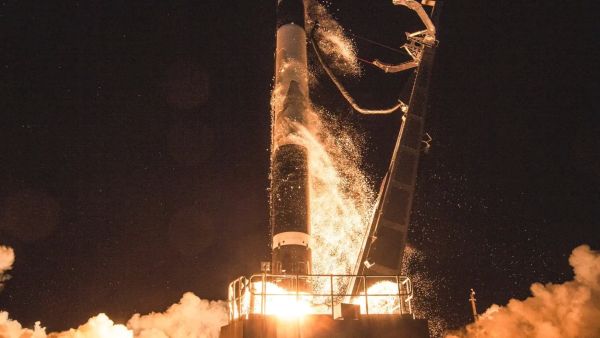
China has shelved plans to launch its Chang'e 7 lunar south pole exploration mission this year. The move adds uncertainty to the rivalry between China and the United States over securing a foothold at the moon’s south pole.
On Aug. 23, Ars Technica reported that China’s manned space programme issued a brief notice saying the Chang'e 7 mission would not meet this year’s planned launch window. China said, "In line with the principle of proceeding prudently and reliably and ensuring absolute success, a comprehensive evaluation found that the Chang'e 7 mission does not meet launch conditions and cannot be carried out in the launch window planned for this year."
China did not officially explain the reason for the delay. Chang'e 7 is a complex mission consisting of an orbiter, a lander, a rover and a small hopping probe. It was scheduled for launch as early as Aug. 23 on a Long March 5 rocket from the Wenchang Space Launch Site on Hainan island in the South China Sea. Its target is the moon’s south pole.
For now, weather is cited as the most likely variable. Typhoon Nari is lingering in waters between Hainan and the Chinese mainland, raising the likelihood of severe weather at the Wenchang launch site. The U.S. Joint Typhoon Warning Center forecast the storm would remain in the same area for several days. In that case, the weather may not improve before this launch opportunity to head from Wenchang to the lunar south pole closes.
A technical issue discovered at the last minute is also not completely ruled out. Observers say a problem could have been detected either in the Chang'e 7 payload or in the rocket. Some also say an engine issue is unlikely to be the direct cause given China had kept the launch schedule unchanged until recently. The Long March 5 shares the YF-100 engine system with the Long March 7A that was lost during ascent 2 weeks ago.
Some observers say the launch could slip to early next year. China has made no official announcement, but social media is circulating claims that the next suitable launch window may not open until February or March next year. The reasons cited include sunlight conditions at the polar landing site and a mission plan requiring 90 days of lunar orbital reconnaissance before landing.
The Chang'e 7 delay comes at a time when the lunar south pole race carries strong symbolism. China and the United States are competing to secure a meaningful foothold at the lunar south pole first. Such robotic missions are seen as a prelude to crewed missions that could follow within the next 2 to 4 years.
Chang'e 7's target area is near Shackleton crater, effectively close to the lunar south pole, and is considered one of the most watched regions on the moon. The crater rim terrain creates permanently shadowed areas, so-called cold traps. These areas have long been thought to possibly hold water ice and other useful materials accumulated over long periods. That is why limited areas of the lunar south pole are seen as central in long-term lunar settlement plans by NASA and China.
No country has yet achieved a soft landing at the lunar poles. The approach is more difficult than near the equator. The delay has also opened the possibility that the United States could reach the terrain first. Blue Origin’s Blue Moon Mark 1 lander plans to carry 2 NASA probes to the lunar south pole.
Blue Moon had also originally aimed for a launch this year, but the schedule was disrupted in May when the New Glenn rocket and its launch pad were lost during a static fire test at Cape Canaveral, Florida. Blue Origin is speeding repairs to its Florida launch facilities and is aiming to resume New Glenn flights before the end of this year. If Chang'e 7 launches in February next year and then undergoes three months of lunar orbital reconnaissance, the race to secure the lunar south pole could be more likely to continue into the first half of 2027.
 Seung-a Yoo
ysah@d-today.co.kr
Seung-a Yoo
ysah@d-today.co.kr