
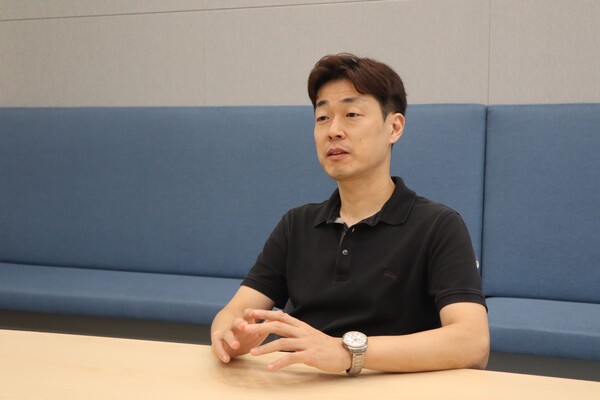
[Digital Today reporter Chi-gyu Hwang] "Hardware trust is important for robotics AI. Hardware that runs without problems is the key. Making a trustworthy robot is not easy. This is a stage where verification is being carried out actively."
Hwang Myeon-jung (황면중), a professor in the Department of Mechanical and Information Engineering at the University of Seoul, made clear that the key to physical AI, including robotics AI, is "hardware stability."
In a recent interview with a reporter, Hwang said the keywords for robotics AI capability are perception and manipulation. Robot performance varies depending on how quickly and accurately it moves after recognizing an object. He stressed that his team is focusing its research capabilities on this area.
Hwang's research team took first place after competing in the RoboCup 2026 ARM Challenge (Autonomous Robot Manipulation Challenge), an international robot competition held each year. It was its third overall win, following victories in 2022 and 2023.
The ARM Challenge is a competition focused on autonomous robot manipulation (ARM), and this year teams competed with recycling sorting robots. Rankings were determined by how accurately and quickly objects were picked up within a set time. In a task requiring dozens of cans, boxes and bottles to be sorted in 30 minutes using a camera and robot, Hwang's team received results showing its robot sorted all items correctly except one.
Hwang's team took a different approach to perception and manipulation in preparing for the competition.
For perception, it tuned an open-source model and implemented it internally. It put particular effort into recognizing objects and generating candidate options for how to grasp them.
For manipulation and control, it used the commercial MathWorks MATLAB engineering software. MATLAB is an engineering programming environment and numerical analysis software that can perform data analysis, algorithm development and system modeling. "MATLAB links well with external models and there are many use cases in physical AI," Hwang said. "Beyond AI functions, it also has strong capabilities in responding to hardware integration. Data formats are standardized, so even if you develop a model in-house, there is no delay as long as you match the format."
Tools such as MATLAB can also be important for robot safety and reliability. "To improve safety, you ultimately have to do a lot of testing," Hwang said. "In this process, we use a lot of simulation. Applying simulation results to a robot is work that requires a lot of know-how. Tools are useful when solving these issues."
Data is also an important factor in physical AI. Data on what actions to take in specific situations has a big impact on performance. "We collected data to test and trained it, and implemented perception capability by loading the trained model onto a laptop equipped with a GPU," Hwang said. "Training requires high-performance computing resources such as the cloud, but inference can be done locally."
Hwang said the team's results in the competition are at a level that can be deployed in real-world settings. "It recognized and sorted accurately even in unstructured environments where items are not neatly placed," he said. "The competition site also had tricky lighting like a typical factory. It can be applied in actual manufacturing sites." He added that manufacturing sites may have fewer items placed than in the competition, and in that environment the number of candidate grasp options can be reduced to further increase speed.
Hwang's lab is developing elements needed for recognition and control, regardless of whether it involves vision recognition, robot manipulators (mechanical devices that mimic the structure of human arms and hands to perform physical tasks such as picking up, moving and assembling objects), or humanoid robots.
In terms of commercialization, it is focusing on manufacturing sites. That is based on the view that demand will increase starting from manufacturing. "In South Korea, physical AI is used a lot in manufacturing," Hwang stressed. "There is also a lot of meaningful data."
Hwang is also placing significant weight on increasing cases of field application, beyond improving robotics AI performance. He appears to be paying particular attention to field verification of humanoid robots. He also sees humanoid robots with two arms mounted on wheels as an attractive option in South Korean manufacturing sites.
"South Korean manufacturing sites tend to be clean, so two arms may be an advantage rather than one," Hwang said. "But having a robot walk on two legs is a burden. A wheeled humanoid robot may be more realistic in South Korea than one that walks. Walking is a high-difficulty movement. It consumes a lot of energy and the likelihood of falling is high."
 Chi-gyu Hwang
delight@d-today.co.kr
Chi-gyu Hwang
delight@d-today.co.kr