
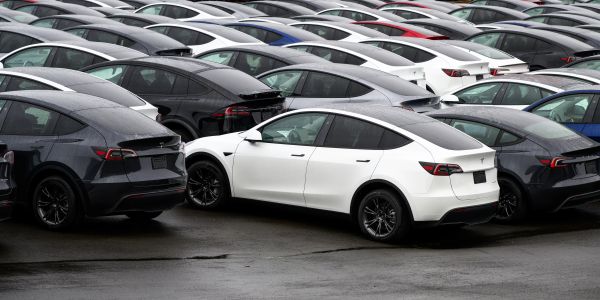
[Digital Today reporter Jinju Hong (홍진주)] Tesla's permitted scope to operate robotaxis has expanded significantly in the U.S. state of Nevada. Tesla, however, said it has no plan to deploy several thousand vehicles immediately, showing a gap remains between regulatory approval and actual service expansion.
CleanTechnica, an electric-vehicle outlet, reported on Aug. 22 (local time) that Nevada expanded its approval to allow Tesla to deploy up to 5,000 robotaxis in the state.
Previously, Tesla could operate only 10 robotaxis on the Las Vegas Strip. The new approval sharply increases the allowed scale. By numbers alone, it could be read as Tesla's robotaxi business entering a full-scale expansion phase.
But the actual pace of deployment is expected to be slower. Tesla officials who attended the meeting said they have no intention of putting 5,000 vehicles on the road right away. That is, the approval expands the maximum permitted scope, not an immediate large-scale deployment of vehicles.
Changes in Tesla's vehicle strategy also appear to be affecting the speed of robotaxi expansion. Tesla is moving toward focusing on its dedicated robotaxi, the Cybercab, rather than rapidly increasing robotaxis based on the Model Y.
With growing confidence in ramping up Cybercab production, the strategy is to expand robotaxi services around the dedicated vehicle after it is ready, rather than deploying Model Ys in large numbers first.
Some point out that this strategy is slowing the spread of the service. Elon Musk (일론 머스크), Tesla's CEO, projected in mid-last year that Tesla robotaxis would cover half of the U.S. population by the end of 2025.
But it is now the second half of 2026. CleanTechnica said Tesla's robotaxi service still does not reach even 10 percent of the U.S. population.
Tesla has also recently begun offering some customers opportunities to ride in the Cybercab. It is also holding prize events for some customers, showing early moves toward commercialising its dedicated robotaxi.
Still, it remains unclear whether this can be seen as a shift to a full-scale, large-scale service. So far, it has a strong experimental character aimed at a limited set of customers.
A key point in Nevada's expanded approval is the difference between the allowed scale and the actual operating scale. A regulatory foundation is now in place to run up to 5,000 vehicles, but when and how many vehicles Tesla will actually deploy is a separate issue.
How quickly Tesla can ramp up Cybercab production is seen as the key variable. At the same time, attention is on how much it can make real the robotaxi expansion targets Musk previously presented.
Nevada's approval expansion is clear progress for Tesla's robotaxi business, but permission to operate 5,000 vehicles does not mean immediate commercialisation of 5,000 vehicles. Production of the Cybercab and the pace of actual deployment are expected to determine whether Tesla's robotaxi business enters full-scale expansion.
 Jinju Hong
hongjj@d-today.co.kr
Jinju Hong
hongjj@d-today.co.kr