
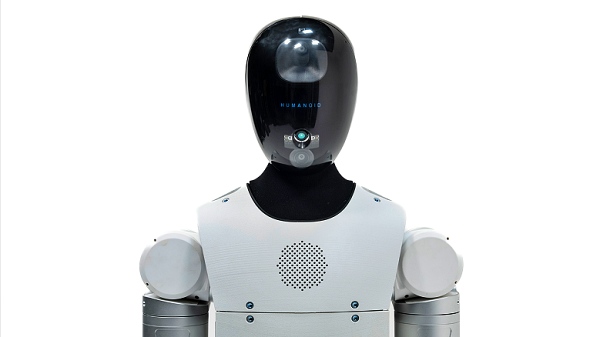
[DigitalToday reporter Jinju Hong] Chinese robotics startup ACE Robotics said embodied AI could face a key turning point for commercialization by the end of 2027. It said more advanced AI models combined with large-scale data accumulated in real environments could allow humanoid robots to move beyond simple demonstrations and be deployed for real work.
Decrypt, a blockchain outlet, reported on Aug. 23 that ACE Robotics Chairman Wang Xiaogang (왕샤오강) said embodied intelligence could reach a so-called 'ChatGPT moment' by the end of next year.
Wang highlighted world models and real-environment data as the core. Unlike language models that learn from text, robots must understand and move in real space, requiring vast data accumulated in physical environments, he said.
The biggest problem facing the humanoid robot industry is also a lack of data. Robots can show motions such as walking, dancing and boxing, but they still have limits in reliably performing diverse tasks in real spaces that are difficult to predict.
Wang said real-world data accumulated by the entire industry over the past few years totals only about 100,000 hours. He said that is far from enough to train embodied-based models.
ACE Robotics plans to secure tens of millions of hours of real-world data within the next 2 years to close that gap. It plans to deploy its technology in 1,000 stores over the next year. The company aims to repeatedly train robots in real stores to recognize their surroundings, judge situations and translate that into action. Its goal is to build data in real spaces with many variables, not simple lab environments.
Embodied AI is a technology that lets robots perceive their surroundings through sensors and actuators, infer situations and then carry out real actions. When combined with world models, robots can also gain the ability to predict what changes might occur around them before taking a specific action.
That is why Wang cited securing environmental data as a key task. He said robots need to learn a sufficient range of situations that occur in the real world to work reliably even in hard-to-predict environments.
ACE Robotics is also expanding quickly. Founded in July 2025, the company is developing AI models for humanoids and is backed by Ant Group and SenseTime. It raised more than $100 million in the first half of 2026 and has also set a policy to pursue an initial public offering as early as possible.
Rivals are also speeding up efforts on embodied AI and securing real-world data. Boston Dynamics said AI technology had moved one step closer to commercial robot deployment when it unveiled a mass-production version of its humanoid robot Atlas in January.
Alibaba also unveiled Qwen-Robot Suite in June to support robot movement, physical task performance and real-environment simulation.
Attempts to secure real-world data for humanoid training are also continuing in research settings. In October, a wearable exoskeleton called HumanoidExo was unveiled that records human movement for use in training humanoid robots.
As competition in the humanoid robot industry expands beyond hardware performance into competition over AI models and real-world data, ACE Robotics aims to bring forward the commercialization timeline for embodied AI by pushing large-scale store deployment and data collection.
Whether it can secure tens of millions of hours of real-world data and use it in robot training is expected to be a key variable in whether embodied AI can move beyond demonstrations and enter everyday workplaces.
 Jinju Hong
hongjj@d-today.co.kr
Jinju Hong
hongjj@d-today.co.kr