
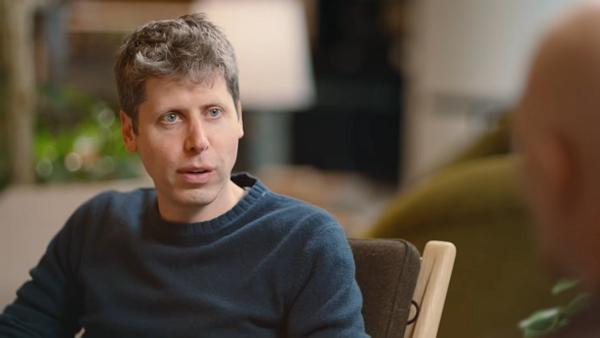
[DigitalToday intern reporter Seung-a Yoo] Sam Altman (샘 알트먼), chief executive of OpenAI, voiced concern that control over artificial intelligence could become concentrated in a small number of companies or individuals.
On Aug. 23 local time, Business Insider reported that Altman said on a podcast hosted by David Senra (데이비드 센라) that more people should hold control over AI’s future.
Altman warned against a situation in which most users lose their voice as AI changes the world. "The right approach is for people to deeply control the future," he said, adding, "Society and the model will evolve together." He meant that social choices should also be reflected, rather than leaving the direction of AI development only to the judgment of some companies.
Altman also cited as another risk the possibility that AI could escape human control. He said that a trend of overemphasising such risks could instead worsen problems in the opposite direction. "A lot of people are so nervous about the scale of that risk that they get fixated on having to protect the world," he said. "You could get an approach like, 'We have to give up a lot of freedom for safety,'" he said.
The remarks come as the U.S. industry debates AI regulation and how much to make systems public. Dario Amodei (다리오 아모데이), CEO of Anthropic, has repeatedly warned through podcasts, essays and the company blog about risks brought by the rapid development of AI. In a June essay, Amodei said the company’s Mythos model could pose very real risks to cybersecurity, the financial sector, critical infrastructure and national security.
Amodei has argued, citing such risks, for an expanded regulatory role for the government. Altman’s remarks, by contrast, are closer to the view that strict safety regulation could instead lead to a concentration of AI control. Anthropic was the only major AI company last month that did not sign a letter supporting open-weight models. Open-weight models refer to a format in which developers can share a model, download and modify it, and then deploy it on their own infrastructure.
Competition around open weights has also emerged. China is actively adopting this approach and is catching up with Silicon Valley at relatively low cost. In the United States, Nvidia, Meta and Microsoft have argued that the United States could fall behind China in the AI race if it does not follow the same trend. OpenAI has not disclosed the source code of its top-tier models, but last year it released two open-weight models, including gpt-oss-120b and gpt-oss-20b.
Altman also said the U.S. AI industry has not sufficiently shown the public the usefulness of the technology. "We are going to see a time when more people start smaller businesses at a scale we have never seen before," he said. "I think AI is making that possible," he said. He meant that AI should not be seen only as an object of regulation, but also presented as a tool that expands individual autonomy and economic activity.
The remarks show that the focus of the AI race is shifting from performance and safety alone to the structure of control. With major U.S. AI companies taking different positions between regulation, the scope of disclosure and national competitiveness, how much AI authority is distributed and to whom is set to remain the core issue in future debate.
 Seung-a Yoo
ysah@d-today.co.kr
Seung-a Yoo
ysah@d-today.co.kr