
[DigitalToday reporter Ho-jeong Lee (이호정)] Kakao’s role for the surviving company KakaoX will change significantly as it separates KakaoTalk and its artificial intelligence (AI) business through a corporate split. Previously, Kakao operated KakaoTalk directly while managing affiliates. After the split, KakaoX will position itself as a “future-value investment company” that grows existing businesses and discovers new growth companies, based on stakes in major affiliates and investment resources.
Kakao plans to bring its “zero-to-one” experience of growing KakaoBank, KakaoPay and Kakao Mobility into new businesses, along with its experience investing in Dunamu, Danggeun and Korea Credit Data, under a single investment company to create new growth engines again.
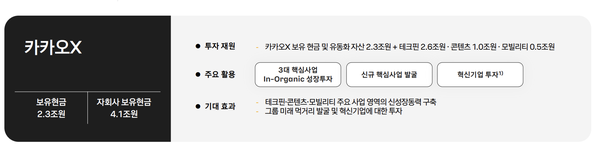
KakaoX will have about 6.4 trillion won in investment resources available from its launch. The total combines about 2.3 trillion won to be secured through asset monetisation including the sale of Kakao Investment’s stake in Dunamu and holdings such as SK Telecom and Kadokawa, plus about 4.1 trillion won in investment capacity held by its tech-fin, content and mobility affiliates.
Kakao plans to use the money not only to support existing affiliates but also for new businesses and investments in innovative companies. It aims to adopt as one of KakaoX’s main growth strategies the approach Kakao used in the past by investing in Dunamu, Danggeun and Korea Credit Data and achieving gains from rises in their corporate value.
◆ From managing subsidiaries to an investment company that finds growth businesses
The core of the corporate split is to separate the two roles Kakao has performed within one company. The newly created KakaoAI will focus on KakaoTalk and AI, advertising and commerce. KakaoX will hold stakes in affiliates and take on the role of managing the portfolio and investing.
Under KakaoX will be tech-fin businesses including KakaoBank, KakaoPay and KakaoPay Securities, content businesses including Kakao Entertainment, SM Entertainment and Kakao Piccoma, and Kakao Mobility. KakaoX is tasked with growing these existing businesses while also finding new businesses and nurturing them into Kakao’s next growth engine.
The background to choosing this structure is a judgment that Kakao’s management resources were being used too heavily to manage affiliates. Over the past 5 years, about 85 percent of the Kakao board’s non-routine decisions involved subsidiary-related agenda items. In internal investment review agenda items over the past year, the share related to subsidiaries reached 84 percent.
Kakao explained that at a time when it needs to focus on its AI business, a significant portion of management resources was used to handle issues such as capital support or loans to subsidiaries.
The split effectively clarifies roles by easing that management burden at KakaoAI while assigning KakaoX to specialise in subsidiary management and investment.
KakaoX will not convert into a holding company. Kakao said it defines KakaoX as an investment company and a portfolio management company, but has no plan to convert it into a holding company. After the split, the CA Council, which served as the group’s control tower, will also not be maintained, and the two companies will each operate independently.
As a result, the criteria for evaluating KakaoX are expected to differ from those for Kakao. Instead of growth in advertising and commerce at KakaoTalk, what will matter is how much it increases the corporate value of affiliates it holds and how efficiently it allocates the capital it secures to new growth businesses.
◆ Where to use 6.4 trillion won... expanding investment in virtual assets, physical AI and global markets
KakaoX will look for new growth areas even within its existing businesses.
In tech-fin, it presented virtual asset and stablecoin businesses as new growth tasks based on KakaoBank, KakaoPay and KakaoPay Securities.
In content, it will expand global fandom and intellectual property (IP) businesses centred on Kakao Entertainment, SM Entertainment and Piccoma.
In mobility, it presented robotaxis, autonomous driving trucks and smart logistics as growth areas. Kakao Mobility is already operating a paid autonomous driving taxi service in the Gangnam area. It plans to increase the number of vehicles to 8 and has also begun investing in robotaxi and logistics. The company cites evolving into a robotaxi operator model and smart logistics based on autonomous driving trucks as areas with future growth potential.
KakaoX also identified physical AI, virtual assets and global fandom as major areas for growth and investment review.
It will also broaden the scope of new investments. It plans to expand innovative-company investments, which had been focused on South Korea and Asia including Dunamu, Korea Credit Data and Kadokawa, to overseas markets including the United States. It will use both an approach of securing management control to grow new businesses directly and an approach of investing in promising companies to support their growth.
Kakao’s revenue target for KakaoX’s core businesses in 2030 is 10 trillion won or more. Assuming the businesses under KakaoX were separate companies, their average annual revenue growth rate from 2023 to 2025 was 8.6 percent. Going forward, based on each affiliate’s business plan, it expects average annual growth of about 13 percent.
That calculation aims to nearly double the related revenue of about 5.6 trillion won as of 2025 by 2030. It does not include KakaoBank revenue because it is not a consolidated subsidiary.
◆ Investment → profit → shareholder returns → reinvestment... aiming for a virtuous capital cycle
KakaoX highlighted as a difference from an existing affiliate management company a structure that links investment performance back to capital allocation and shareholder returns.
KakaoX will return 30 percent of dividend income received from subsidiaries to shareholders. If profits arise from the sale of investment assets, it will also return 30 percent of investment gains as a special dividend and invest the remaining 70 percent in new investments. It aims not to accumulate all gains from investments inside the company, but to return part to shareholders and use the rest again as growth funding.
It also set out a first case. From 1.6 trillion won in proceeds from Kakao Investment’s sale of its stake in Dunamu, it plans to use 300 billion won, about 30 percent of the investment profit after excluding invested principal and taxes, for share buybacks and cancellations.
Ultimately, KakaoX’s business model is not completed simply by “holding good companies.” It needs to support the growth of existing affiliates, find new investment targets and then connect the value and cash created there to shareholder returns and the next investments.
A key task for KakaoX is whether it can turn the investment functions Kakao previously carried out across various businesses and companies into a repeatable capital allocation structure within a single listed company.
Kakao plans to build a virtuous cycle through KakaoX in which investment and growth, shareholder returns and rises in corporate value follow one another. The 6.4 trillion won in investment capacity is the starting point. Ultimately, KakaoX’s corporate value is expected to depend not on the size of its assets itself, but on where it allocates capital and how much performance it creates from those investments to link back to shareholder returns and reinvestment.
 Ho-jeong Lee
lhj@d-today.co.kr
Ho-jeong Lee
lhj@d-today.co.kr