
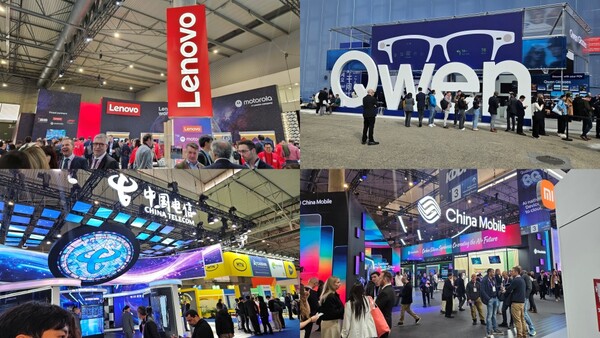
[DigitalToday reporter Hyunwoo Choo (추현우)] China’s three state-owned telecom operators are growing AI token-charging businesses into a new growth pillar. As AI adoption and computing demand rise quickly in China, China Mobile, China Telecom and China Unicom presented AI and computing businesses as key growth drivers in their first-half results released this month, the South China Morning Post reported on Aug. 21 local time.
The three companies highlighted token usage, the basic unit of data processed by AI models, as a key indicator along with computing power and data. They did not disclose separate revenue from token businesses, the number of active customers, monthly usage or profit margins.
China Telecom said first-half revenue from intelligent computing surged 95 percent. Revenue from intelligent businesses rose 7.1 percent to 31.1 billion yuan. It offers token packages to mobile users nationwide, and its "Xingchen Token Hub" hosts 142 large language models and more than 420 industry-specific AI applications. "Xilang," software that coordinates computing resources and networks, was upgraded to support more than 20 chip architectures. China Telecom’s cloud revenue rose 7.8 percent to 61.8 billion yuan.
China Unicom’s first-half computing power revenue rose 13 percent to 41.9 billion yuan. That includes data centres, leased computing, enterprise software and cloud-based AI. China Unicom launched a "token supermarket" as part of an ecosystem linking the creation, transfer, storage and use of AI tokens. Its UniAI platform connected to more than 200 large language models and secured more than 500 terabytes of high-quality data. First-half 2026 capital expenditure on computing infrastructure rose more than 80 percent from a year earlier, accounting for more than one third of total capital spending.
China Mobile reported first-half revenue from computing services rose 14 percent to 52.9 billion yuan, and revenue from AI services increased 0.9 percent to 49.3 billion yuan. Combined revenue from the two businesses accounted for 22.6 percent of core business revenue. Revenue from high-performance computing used for model training and operations rose more than 130 percent to 5.3 billion yuan. China Mobile presented a "token factory" strategy combining model, computing and data centre capabilities, token product pilot programmes by region, and an enterprise multi-AI-model access platform called "Moma."
Companies outside telecoms have also moved to monetise the token economy. Chinese AI solution provider Fancy Group said API service revenue rose more than 860 percent from a year earlier to 460 million yuan. Over the same period, token consumption rose about 620 percent. China’s National Data Administration estimated that China’s average daily AI token calls exceeded 140 trillion in March. That is a sharp increase from 100 billion two years ago and, based on a population of about 1.4 billion, amounts to about 100,000 tokens per person.
 Hyunwoo Choo
cookinpapa@d-today.co.kr
Hyunwoo Choo
cookinpapa@d-today.co.kr