
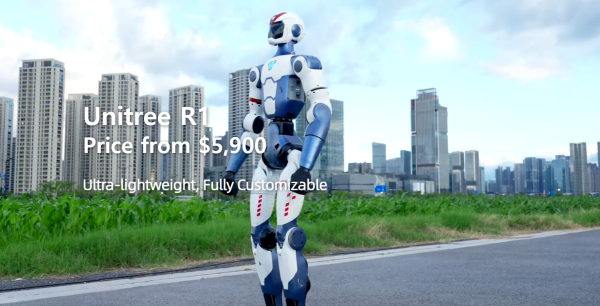
The humanoid robot industry could face a “ChatGPT moment” in as little as 2 to 3 years, or in 5 to 10 years at the latest, a forecast showed.
On Aug. 20, blockchain media outlet Cryptopolitan reported that Unitree CEO Wang Xingxing (Wang Xingxing) said at the World Robot Conference in Beijing that the turning point could come in 2 to 3 years under ideal conditions, or in 5 to 10 years if progress is slow.
Wang set a target for robots to carry out about 80 percent of assigned tasks using only voice and text instructions, even in homes or workplaces they encounter for the first time. He explained that reaching that stage would be a key inflection point that leads to explosive growth in the robot industry.
That differs somewhat from overheated market sentiment right after Unitree's listing. Unitree became the first humanoid robot company to list on China's A-share market on Aug. 19, and the stock ended trading up 460.34 percent from its IPO price. As a result, the Hangzhou-based company was valued at 340 billion yuan, about 69.904 trillion won.
He also pointed to limits of current technology. He said a robot that has learned enough in a fixed location may appear to have a 100 percent success rate, but performance drops sharply if an object changes or the surrounding environment shifts even slightly. The remarks suggest there remains a large gap between humanoid robots' inputs and outputs and the real physical environment.
In particular, the inability to correct small errors that occur in the real world was identified as the biggest bottleneck at present. Limits of artificial intelligence models that handle robots' decision-making and interaction were also cited as factors blocking large-scale adoption. Wang acknowledged that Unitree also still lags in applying physical AI to real-world sites.
Even within the industry, views on timing differ. Wang He (왕허), founder of robot startup Galbot, said he expects the robot industry's “ChatGPT moment” to come around 2028. He set the benchmark as the point when robots can handle 70 to 80 percent of everyday tasks without separate training.
Support at the Chinese government level is also continuing. A report by a Chinese industry group said China shipped more than 40,000 humanoid robots in the first half of this year, accounting for 97 percent of global shipments. A State Council-affiliated research centre forecast the physical AI market will exceed 400 billion yuan, about 82.24 trillion won, in 2030 and 1 trillion yuan, about 205.61 trillion won, in 2035.
Still, warnings have also emerged that the market will not grow on supply expansion alone. Beijing's economic planning authorities asked manufacturers not to flood the market excessively with similarly designed products. The U.S. Federal Communications Commission last month banned future imports of foreign-made humanoid and quadruped robots for national security reasons. As a result, market focus is shifting from shipment competition to versatility in performing real tasks in unfamiliar environments and to policy variables.
 Yoonseo Lee
yslee@d-today.co.kr
Yoonseo Lee
yslee@d-today.co.kr