
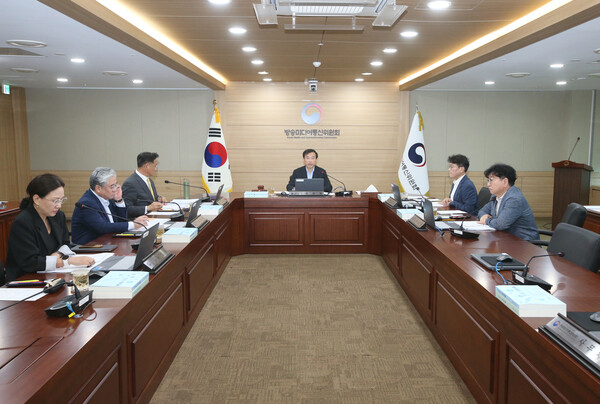
South Korea’s Broadcast Media and Telecommunications Commission sought to begin a hearing procedure to review whether to cancel a decision approving Eugene ENT as YTN’s largest shareholder, but failed to reach a vote after falling short of a quorum.
At its 29th plenary meeting on Aug. 21, the commission discussed an agenda item on holding a hearing for Eugene ENT. The agenda was aimed at reviewing whether the approval decision made in February 2024 by the former Korea Communications Commission on Eugene ENT’s change in its status as YTN’s largest shareholder was illegal in procedure or substance, and at conducting a hearing with Eugene ENT before deciding whether to cancel the decision.
Kim Jong-cheol (김종철), the commission chair, recused himself from deliberating the item. Ko Min-su (고민수), elected first vice chair that day, led the meeting as acting chair.
Ko said the hearing was a procedure to hear the party’s views and examine evidence. He said the item was taken up to ensure the decision is careful and appropriate. He added that the commission also considered provisions of the Administrative Procedures Act that allow procedures to be resumed if circumstances change after a hearing.
◆ Choi Soo-young and Lee Sang-geun: "Court ruling first"...refuse to deliberate and vote
Opposition-nominated members Choi Soo-young (최수영) and Lee Sang-geun (이상근) refused to deliberate or vote on the item and left the meeting. Choi said the commission had held meetings of a legal advisory group and member briefings and heard the views of Eugene ENT and YTN, but that no new facts or legal grounds had been presented since members made their positions public a week earlier to overturn prior reviews.
He said it was difficult to confirm urgent circumstances that could not wait for a court ruling or a public-interest reason to begin an ex officio cancellation. He opposed the move on the grounds that if an administrative body makes a decision before an appellate ruling, it could affect the trial and increase uncertainty.
Choi also said a hearing should not become a procedure that supports a conclusion decided in advance. He said it was reasonable to watch for new developments such as a court ruling.
Lee agreed with Choi and declared he would not participate. Lee voiced concerns about taking administrative action based only on a first-instance decision and said procedures should be followed through a Supreme Court ruling. He also mentioned the possibility that issues such as abuse of authority or damages claims could be raised against individual members after an ex officio cancellation.
◆ Only 3 members remain, falling short of quorum..."Will keep addressing the hearing"
After the two members left, only Ko, Ryu Shin-hwan (류신환) and Yoon Sung-ok (윤성옥) remained in the meeting room. The law establishing the commission requires at least 4 members present to open a meeting and approval by a majority of those present to pass decisions. The secretariat said legal review was needed because proceeding with deliberation and a vote with only 3 members could raise questions about legality. Ko then did not proceed with a voting process.
Yoon expressed regret over the departure of the opposition-nominated members. Yoon said a hearing under the Administrative Procedures Act is a procedure to guarantee a party’s right to defend itself, not to decide a conclusion in advance. Yoon said the commission needed to hear Eugene ENT’s views to determine whether there had been procedural or substantive illegality.
Yoon said it was "deeply regrettable" that the hearing was described as a procedure with a conclusion set in advance. Yoon said refusing to carry out such a procedure made it hard not to question whether members were fulfilling their responsibilities.
Ko also stressed that an administrative body can cancel its own illegal or improper decision. Ko said the commission had conducted fact-finding and obtained legal advice, but some members judged the evidence investigation was insufficient. Ko said the commission sought to hold a hearing before deciding whether to make a final cancellation.
Ko said it was also necessary to examine issues related to the decision-making主体 of the former commission. Ko said that if an unauthorized person makes a decision, it could amount to serious illegality reaching nullity. Ko said the commission would continue to address the issue of a hearing for Eugene ENT.
After discussion on the item ended, Kim returned to the meeting room and said he felt heavy-hearted that the discussion could not be concluded while two members were absent. Kim said it was desirable to discuss fully and express views in the meeting room where different ideas are produced and exchanged even if opinions differ.
The dispute began in February 2024 when the former Korea Communications Commission, then operating with 2 members, approved Eugene ENT’s change as YTN’s largest shareholder. A court later ruled to cancel the approval decision after finding procedural illegality, and a higher-court review is under way.
Within the commission, opinions are split between waiting for the court’s ruling and separately reviewing illegality and proceeding with a hearing. Discussion over YTN’s largest shareholder is expected to continue.
 Jin-ho Lee
jhlee26@d-today.co.kr
Jin-ho Lee
jhlee26@d-today.co.kr