
LG Energy Solution is accelerating local production in the North American battery market. LG Energy Solution said on Aug. 19 it held an opening ceremony for its Lansing plant in Michigan and has begun full operations. Michigan Governor Gretchen Whitmer, U.S. Interior Secretary Doug Burgum and LG Energy Solution CEO Kim Dong-myung (김동명) attended.
The Lansing plant is LG Energy Solution’s seventh production facility in North America. It will operate as a mixed manufacturing hub producing both LFP (lithium iron phosphate) batteries for ESS (energy storage systems) and NCM (nickel, cobalt and manganese) batteries for electric vehicles. It has total annual battery cell capacity of more than 35 GWh.
LFP products for ESS will be supplied to power infrastructure and AI data center customers through Vertech, LG Energy Solution’s ESS system integration subsidiary. LG Energy Solution has secured about 140 GWh in North American ESS order backlog as of the end of last year, and signed new orders worth more than 3 trillion won in the first half of this year alone. EV batteries are expected to be installed in models including the 2027 Highlander produced at Toyota’s Georgetown plant in Kentucky.
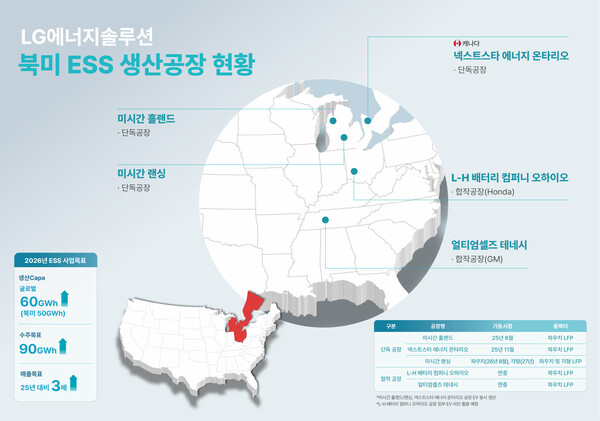
With the start-up of the Lansing plant, LG Energy Solution has completed a network of 5 production hubs targeting the North American ESS market. It consists of 3 standalone sites, including the Lansing and Holland plants in Michigan and the Ontario plant in Canada, and 2 joint ventures: L-H Battery Company with Honda in Ohio and Ultium Cells with GM in Tennessee. The company said LG Energy Solution is the only global battery maker in North America with such a diversified production system.
CEO Kim said the start-up of the Lansing plant is an important milestone that will accelerate the growth of LG Energy Solution’s North American business. He said the company will build a state-of-the-art battery manufacturing network to support the future of the U.S. mobility industry and energy infrastructure, strengthen the U.S. battery ecosystem and expand local production capacity.
 Dae-geon Seok
d2dg@d-today.co.kr
Dae-geon Seok
d2dg@d-today.co.kr