
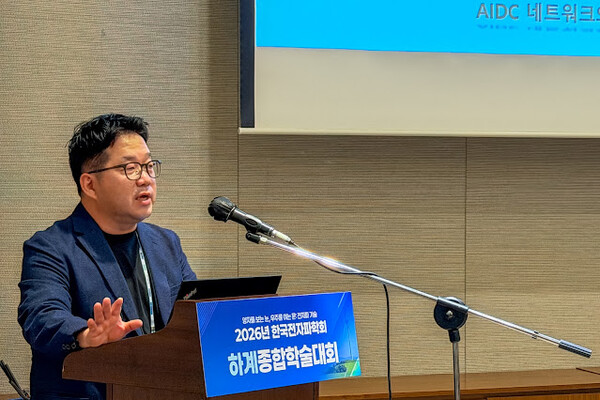
KT said on Thursday it held a special session at the Korean Institute of Electromagnetic Engineering and Science summer conference on Aug. 20 and discussed the direction of AIDC network and infrastructure development with officials from industry, academia and research institutions.
The session, held at the Alpensia Resort in Pyeongchang, Gangwon Province, was chaired by Kim Woo-tae (김우태) of KT's Future Network Lab under its Network Division, with participants including officials from the Electronics and Telecommunications Research Institute (ETRI) and AI infrastructure companies Panmnesia and Vertiv.
KT explained that as physical AI and AI agents spread, demand for computing is rising rapidly, increasing the importance of infrastructure such as AI data centres. It stressed that future AI infrastructure competitiveness will depend on efficiency that enables more services with the same resources and power.
KT presented key development directions including next-generation networking technology that connects AI infrastructure, AI data centre structures that raise computing resource utilisation, and AI data centre construction methods that improve power and cooling efficiency.
It introduced next-generation networking technology to connect AI infrastructure efficiently. It also explained a Compute Express Link (CXL)-based AIDC structure that increases utilisation of AI resources. CXL is a computing interconnect technology that supports flexible sharing of resources such as processors, memory and AI accelerators between servers as needed.
In data centre environments where AI resource usage differs by server, using CXL can allocate idle resources to servers that need them, enabling more computing on the same infrastructure. It said this can improve operational efficiency and scalability.
The session also discussed ways to apply modular data centres to improve power and cooling efficiency. A modular data centre integrates and manufactures power and cooling facilities in advance and then installs them on site. It has advantages including reducing heat generation, power consumption and construction time, and can be applied to AI data centres of various sizes.
KT said it plans to continue developing integrated AI infrastructure technology that organically connects AI data centres and AI networks based on the discussions. It said it aims to implement high-efficiency infrastructure to respond to growing demand for AI services and support AI transformation across industries.
Lee Jong-sik (이종식), executive director and head of KT's Future Network Lab under its Network Division, said, "In the AI era, it is becoming more important how efficiently you use infrastructure than building more of it." He added, "KT will support AI transformation across industries based on integrated AI infrastructure capabilities spanning networks and AI data centres."
 Jin-ho Lee
jhlee26@d-today.co.kr
Jin-ho Lee
jhlee26@d-today.co.kr