
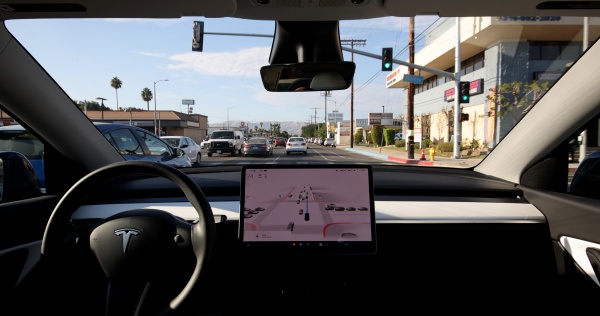
A privately modified Tesla case in which the older self-driving computer HW3 was replaced with the latest HW4 has been made public, raising interest in whether Tesla will officially push hardware upgrades for existing vehicles.
On Aug. 18 local time, electric vehicle outlet Electrek reported that Polish Tesla owner Michal Gapinski (미하우 가핀스키) carried out work to replace HW3 installed in a 2022 Model 3 with HW4. Gapinski runs a company called Tesla Android that links Android functions to Tesla vehicles.
Gapinski disclosed the results of his modification and said the job was not as difficult as expected. He said the work required only about "light ECU hacking" and that the hardware work was done using epoxy and cable ties.
Not all functions have been implemented normally yet. Gapinski said additional work is needed for full functionality. The materials released so far show only service-mode screens and photos of the process, and no real-road driving video has been released.
The case is drawing attention because it is tied to Tesla's FSD (Full Self-Driving) hardware upgrade issue. Tesla has previously said all vehicles produced from 2016 have the hardware needed for full self-driving in the future. But as self-driving technology developed, some pointed out that not only early HW1 but also HW3 may be insufficient to achieve full self-driving in the future.
Tesla previously provided free HW3 upgrades to owners who bought FSD. But moving from HW3 to HW4 is not simply a matter of replacing the computer. Tesla has said the difficulty is high because related parts, including cameras, must also be changed, and the burden of parts and labor is large given the target fleet runs to several million vehicles.
Tesla Chief Executive Elon Musk (일론 머스크) mentioned in April a plan to install "microfactories" in major cities to carry out hardware replacement work on a large scale. No specific execution plan or progress has been disclosed since then.
Against this backdrop, Gapinski said the swap from HW3 to HW4 could be confirmed even at an individual level, and suggested Tesla "could have done" the upgrade much earlier.
Of course, there is a big difference between an individual modifying a single vehicle and Tesla carrying out an official upgrade for several million vehicles. For an automaker to replace hardware officially, it must resolve issues including parts supply, certification, safety verification, software compatibility and after-sales service.
The key issues ultimately come down to cost and responsibility. Gapinski said Tesla could consider offering HW4 upgrades as a paid option. But among owners who bought FSD licenses, there are also calls for a free upgrade, based on Tesla having sold vehicles while saying they had hardware capable of supporting full self-driving.
Legal disputes over FSD performance are also continuing. Some owners have filed small-claims lawsuits, and class actions are under way in several regions. Tesla has responded in related lawsuits with a message asking owners to be patient.
In particular, the level 5 full self-driving Tesla once promised has not yet been implemented in any vehicle. FSD now provided also requires the driver's continuous attention and intervention.
Tesla's method of selling FSD is also changing. The company is now focusing on offering FSD as a monthly subscription rather than a one-time purchase. It appears to be reshaping the product structure to match what it can provide now, rather than selling for a long period on the premise of future performance.
A policy allowing FSD licenses on existing vehicles to be transferred to a new vehicle is also no longer supported, which could further increase dissatisfaction among existing owners with HW3 vehicles.
Further verification is needed on whether this private modification case can actually implement all functions. But as the possibility of an individual-level "HW3-to-HW4" swap has been made public, debate is expected to grow over what hardware upgrade plan Tesla will offer to existing FSD buyers.
The key going forward will be whether Tesla acknowledges the limits of HW3 vehicles and introduces an official HW4 upgrade program, and if it does, who will bear the cost. The wider the gap grows between past promises and actual performance around FSD, the more likely the hardware upgrade issue is to emerge as a major risk for Tesla.
 Jinju Hong
hongjj@d-today.co.kr
Jinju Hong
hongjj@d-today.co.kr