
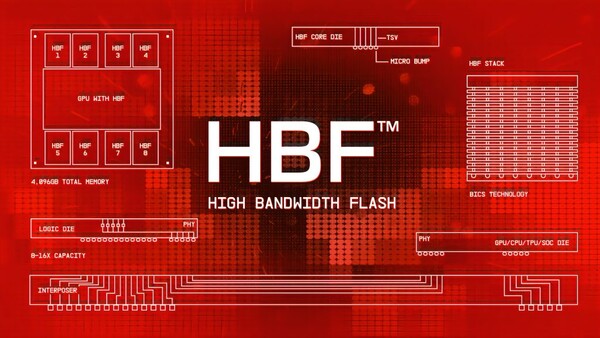
SK Hynix is moving to set global standards for next-generation memory HBF aimed at the AI inference era.
SK Hynix and SanDisk on Feb. 25 (local time) held an event titled the HBF spec standardisation consortium kickoff at SanDisk's headquarters in Milpitas, California, and announced their standardisation strategy for HBF (High Bandwidth Flash). The two companies will jointly form a dedicated workstream for key tasks under the OCP (Open Compute Project), the world's largest open data centre technology collaboration chain, and begin standardisation work.
HBF is a new memory tier positioned between ultra-high-speed HBM and high-capacity storage SSDs. It fills the gap between HBM performance and the high-capacity characteristics of SSDs, securing both capacity expansion and power efficiency required in inference.
As the number of AI service users surges, fast and efficient memory is essential. But it is difficult for existing memory architectures alone to meet both large-scale data processing and power efficiency required at the inference stage. HBF has emerged as an alternative to address these limits.
The company expects HBF to increase the scalability of AI systems while reducing overall operating costs. The industry expects demand for hybrid memory solutions, including HBF, to expand in earnest around 2030. SK Hynix and SanDisk plan to proactively pursue rapid standardisation and commercialisation of HBF based on the design and packaging technology and mass production experience they have built in HBM and NAND.
Ahn Hyun (안현), president and head of development at SK Hynix, said, "The core of AI infrastructure goes beyond performance competition of a single technology to optimising the entire ecosystem." He added, "Through standardisation of HBF, we will build a cooperation system and create new value by presenting an optimised memory architecture for customers and partners in the AI era."
 Daegeon Seok
d2dg@d-today.co.kr
Daegeon Seok
d2dg@d-today.co.kr