
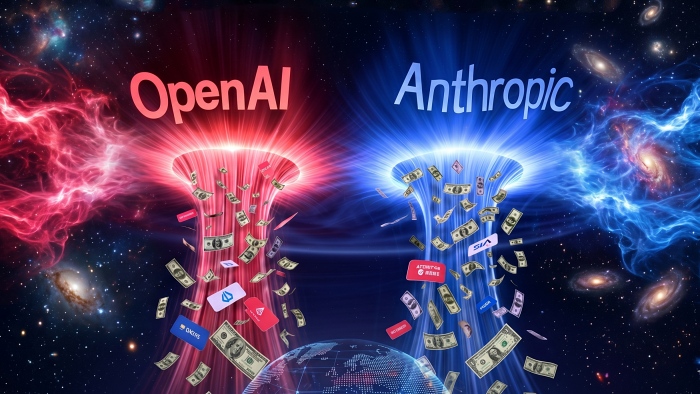
OpenAI and Anthropic, which lead the global frontier AI model market, are speeding up development of their own AI-based apps. That appears to be making ties increasingly delicate with service providers that build apps based on the two companies' AI models. Scenes are emerging in which customers who pay to use OpenAI and Anthropic model APIs to build services must also compete with the two companies.
The Information recently reported that design software company Canva, which has more than 200 million users, told investors in August it cut its forecast for this year's revenue growth rate to 20 percent.
After OpenAI launched a new image model in April that supports making designs such as posters, some Canva users moved to ChatGPT, The Information reported, citing a source.
Canva is moving to smaller models from OpenAI and Anthropic and to open-source models, while also developing its own model, as it seeks to cut costs. It is also pushing to introduce a usage-based pricing plan.
Cliff Obrecht (클리프 오브레히트), a Canva co-founder, said service costs for free users were very low before adopting AI, but rose sharply after AI adoption, changing the profit structure. He said it is now moving into a phase where the company must prove profitability in its AI business, or a path to securing it.
This could increasingly become a "new normal" for AI service companies. As Microsoft expanded from Windows into applications and Google broadened into various services by leveraging dominance in search, large AI model developers are also increasingly expanding their own service lineups, even if it is uncomfortable for service providers, the article said.
Service companies may believe they can stay competitive if they build good services using model APIs, but it may not be that simple. That is because signals are growing that the scope of access to advanced AI models through APIs could become narrower than before.
The Information reporter said that after speaking in recent weeks with researchers at these frontier AI companies and with founders of companies building services based on the latest models, signs are strengthening that Anthropic and OpenAI could restrict API access to their best-performing models or reduce performance, whether by their own choice or in response to government demands.
The Trump administration has recently pressured OpenAI and Anthropic to follow procedures to release some models in stages rather than all at once, citing concerns that some models could be misused by cybercriminals or other malicious forces. During that period, customers must receive individual approval.
The Information reported that even after Anthropic and OpenAI release models publicly via APIs, they can intentionally lower model performance for certain tasks for safety reasons, and that Anthropic has done so in cyber security-related tasks involving the Fable model.
As Anthropic unveiled the Mythos-based Fable5 model, it said it would lower model performance without notice if the model was used to develop AI models or hardware, heightening a sense of crisis among Anthropic customers. After pushback, Anthropic stepped back and said it would inform customers and then lower performance, but some concerns remain.
Anthropic and OpenAI could apply the same standards to internal projects as they do to what they provide externally, but it is unclear whether they will. The Information reported that if Anthropic or OpenAI uses its models to run its own apps or specific functions, there is no need to restrict model performance.
OpenAI and Anthropic are unlikely to abandon API sales, a major revenue source, to grow services. But for OpenAI and Anthropic, which must strengthen profitability ahead of initial public offerings, the strategic value of AI-based apps is in fact increasing.
The Information added that some investors are already warning developers about the possibility that Anthropic may not provide its best AI technology to external developers and may use it only for its own products.
There is another reason Anthropic and OpenAI could increasingly limit API access to their advanced models. The stated purpose is to prevent distillation.
Distillation is a technique that trains a new model using outputs produced by a high-performance model. Chinese AI companies in particular are using it to pour out high-performance models in open-source form that rival those of U.S. companies.
Amid this, Anthropic warned in an August report on potential catastrophic risks its AI could cause that if a model created through distillation inherits capabilities tied to the original model's risks but is offered without sufficient safeguards, it could bring risks to the world as the original model's capabilities carry over into another model, even if the original model has strong misuse-prevention safeguards.
 Chi-gyu Hwang
delight@d-today.co.kr
Chi-gyu Hwang
delight@d-today.co.kr