
Building gigawatt-scale artificial intelligence (AI) factories in South Korea is getting under way, but critics say Taiwanese companies control the server assembly and cooling components supply chain, leaving Korean materials and parts makers sidelined. As Nvidia decides to supply compute trays fully assembled from its next-generation Vera Rubin platform, assembly partners have narrowed to three companies: Foxconn, Quanta and Wistron. Taiwanese companies Auras and AVC have secured an early lead in liquid-cooling components.
Work to build AI factories in South Korea has gathered pace. SK will receive graphics processing units (GPUs) from Nvidia and build the country’s largest AI factory with a capacity of up to 2 GW. The project, linked to SK Hyper established by SK Telecom, is set to begin operations in stages from 2027. Naver will secure GPUs and enter the business-to-business (B2B) cloud business after receiving a total investment of $10 billion from Nvidia and Brookfield. Naver plans to use its "Gak Sejong" data centre as a base, increasing capacity step by step from 55 megawatts (MW) in the first half to 200 MW by 2028.
Demand for AI data centres in South Korea is expected to grow further. Hana Securities presented effective demand for additional AI data centres needed in South Korea by 2030 at 3.0 to 4.2 GW under a base scenario and 5.1 to 7.0 GW under an optimistic scenario. Given that building AI data centres costs $50 billion to $60 billion per 1 GW at current standards, applying the current unit cost to the top end of the optimistic scenario of 7 GW implies investment of up to $420 billion in South Korea.
But the destination for large-scale investment is Taiwan. Nvidia currently supplies AI factories with fully assembled L10 compute trays from the Rubin generation. JPMorgan analysed that the tray accounts for about 90 percent of server costs and that original design manufacturers (ODMs) and hyperscalers will no longer directly design mainboards or cooling systems. With a cable-free design and automated processes, only Foxconn, Quanta and Wistron can respond to this structure, and the role of ODMs has narrowed to rack integration and power and cooling distribution.
Foxconn takes 40 percent and Quanta 30 percent of GB200 AI server volume, which will be central to AI factories. According to Morgan Stanley, Nvidia shipped about 1,500 GB200 server cabinets in April last year. Of those, Foxconn accounted for about 1,000 units and Quanta 300 to 400 units. Foxconn’s revenue in April last year was 641.3 billion Taiwan dollars, up 25.5 percent from a year earlier.
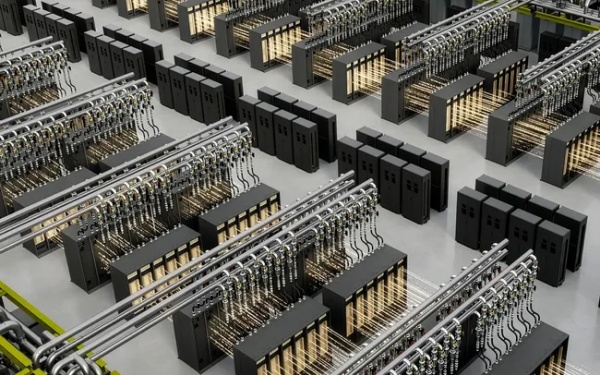
The same applies to cooling components. As rack-unit designs become established, cooling has become an essential element of AI factories. iM Securities estimated that the FP8 computing performance of the Vera Rubin NVL72 would rise about 3.5 times versus the GB300 NVL72, and high-bandwidth memory (HBM) bandwidth would increase about 2.7 times. Performance per watt improves, but absolute power consumption per rack rises instead, according to iM Securities.
Nvidia adopted a fully liquid-cooled structure without fans as a standard for Vera Rubin servers and designated Taiwanese companies as cold-plate suppliers. As a result, Auras hit a record high of 1,305 Taiwan dollars on April 27, with a five-year return of 565 percent and a market capitalisation of 92.4 billion Taiwan dollars. AVC’s share price has risen 600 percent since the end of 2022, with a market value of 3.35 trillion Taiwan dollars, and its server revenue in the second quarter of this year was 32.4 billion Taiwan dollars, up 6.9 times from the first quarter of 2024.
Nvidia and Taiwan ODM monopoly structure...what about Korea’s materials and parts makers? "Only indirect supply"
By contrast, access routes for Korean companies to AI factories are concentrated on hyperscalers rather than direct deliveries to Nvidia. LG Electronics signed a contract to supply Microsoft’s global AI data centres with a thermal management solution bundling cold plates, a coolant distribution unit (CDU) and a water-cooled chiller. At Data Center World 2026, it unveiled a CDU that increased cooling capacity from 650 kilowatts (kW) to 1.4 MW. Orders for data-centre chillers tripled from a year earlier last year, which is expected to bring forward a target of 1 trillion won in revenue in 2027.
Samsung Electronics rolled out a CDU called "Liquid-Denko" with capacity of up to 1.6 MW after acquiring European heating, ventilation and air conditioning (HVAC) company FlaktGroup. The direct-to-chip (DTC) method supplies coolant directly to chips, and the possibility of applying it to its own semiconductor fabs has also been discussed. Samsung SDS completed a proof of concept for immersion cooling and filed 4 domestic patents, and plans to expand it by 2030 after a pilot application at its Dongtan data centre. SK Enmove is participating by incorporating immersion-cooling fluid into a three-party cooperation with LG Electronics and GRC.
Korean materials, parts and equipment companies are being left out of the benefits from AI factory construction. Entry by Korean companies is only possible at the level of large-company partners. This is because Nvidia and Taiwanese ODMs take finished-product assembly and tray supply. For Korean suppliers, the only options are to supply fully assembled products directly to Nvidia or to follow parts standardisation tied to designation as cold-plate suppliers.
Nvidia manages partners through a system called the Nvidia Partner Network (NPN). NPN is divided into 4 families: AI Infrastructure, Cloud, Influencer, and Seller/Builder. The AI Infrastructure family is in turn made up of three partner types. They are data centre partners responsible for data centre design and construction, Power & Cooling partners that supply power and cooling solutions, and AEC partners that handle architecture, civil engineering and design.
The market itself is open. Taiwan News reported that the global data centre liquid-cooling market is worth $5.7 billion this year and is expected to grow at a compound annual rate of 26.4 percent through 2033. An industry official said it is "virtually difficult" for Korean companies to enter the Nvidia Partner Network, adding, "In the end, for now, the only way is to supply indirectly to existing Taiwanese ODM companies."
 Suk Dae-geon
d2dg@d-today.co.kr
Suk Dae-geon
d2dg@d-today.co.kr