
Finnish smart ring maker Oura (OURA) has officially entered the South Korean market with its Oura Ring 5, which it says is 40 percent smaller than its previous model. It reduced the ring to 6.09 mm wide and 2.27 mm thick, while quadrupling LED output and increasing signal paths to 12 to secure measurement signals. Oura provides more than 50 health metrics in its app, including sleep, stress and women's health.
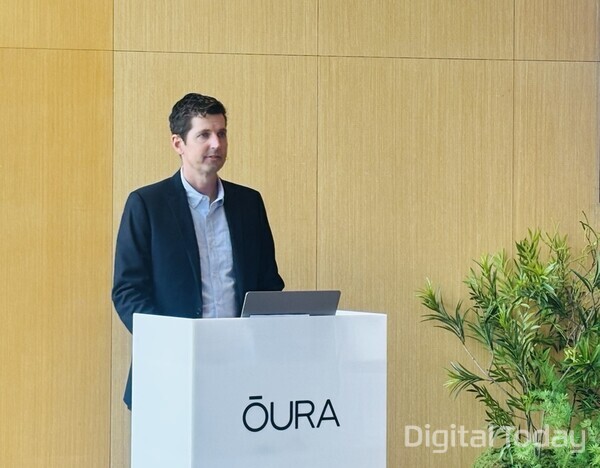
Oura held a media briefing in Seoul on Monday and announced its official entry into South Korea and its plan to launch the Oura Ring 5. Brian Lynch (브라이언 린치), Oura's senior vice president of hardware engineering, said, "It wasn't just about reducing components. We had to redesign the mechanical and electrical architecture from scratch." He said the company pursued miniaturisation on the condition it would not compromise on features and battery life.
The new Oura Ring 5 is 6.09 mm wide and 2.27 mm thick, making it 40 percent smaller than its predecessor. Oura said it addressed the problem of weaker signals received by optical sensors when reducing thickness by quadrupling LED output and increasing signal paths to 12. Lynch said the signal stays consistent even during high-movement activities such as walking, running and cycling. The battery uses a newly designed structure and can last up to 7 days on a single charge depending on usage. It weighs 2 to 2.69 grams depending on size.
The company also presented its rationale for choosing the finger as the measurement site. Oura said finger arteries deliver pulse signals to optical sensors that are up to 100 times stronger than the wrist. It said this follows the same principle as hospitals placing oxygen saturation monitors on fingertips, giving it an advantage in signal strength versus wrist-worn devices. Lynch said it achieved accuracy close to electrocardiograms (ECG) for heart rate and heart rate variability (HRV), and 92 percent accuracy for skin temperature against laboratory standards. Oura did not disclose which wearable chipset company it uses inside the Oura Ring 5.
Oura's hardware organisation is led by former Apple staff. Lynch worked at Apple for 24 years and served as senior director of home hardware engineering. George Abbott (조지 애벗), who oversees the South Korea expansion as head of Europe, the Middle East and Africa and Asia-Pacific, also handled market entry strategy planning and execution at Apple.
◆"You are buying the app and insights, not the hardware"
Health data collected through the Oura Ring can be viewed in the app. It provides three daily scores for readiness, sleep and activity, and offers more than 15 insights. It measures at 15-minute intervals to show periods throughout the day when the body moved in and out of stress states, and lets users tag specific moments to trace causes. Abbott said, "The stress feature will resonate in Korea."
Women's health is an area Oura has presented as a point of differentiation. In addition to menstrual cycle insights and a hormonal birth control feature, pregnancy insights use longitudinal analysis based on more than 10,000 pregnancy data points to show trimester-by-trimester biometrics compared with population data.
It also provides insights for menopausal women. Oura applies its in-house 'Menopause Impact Scale.' Abbott said more than 1 billion people worldwide are in the pre- and post-menopause stages but rely on assessment tools from decades ago. He said it is designed to measure symptom severity using structured questions on sleep, mood, cognition and daily functioning, track changes on a dashboard, and share results with medical staff for treatment discussions.
On the timing of the Oura Ring 5 entry, Abbott said, "We chose to do it properly rather than quickly," and said it needed time to complete localisation of the product and marketing. He said the company judged this launch to be the right time to enter South Korea and that it came to market with a product reflecting improvements built up through the fifth generation.
Oura plans to offer a membership that combines hardware sales with a monthly subscription. New features, including menopause insights, will also be provided to members. The structure adds a membership fee of about 9,400 won to a device price of 630,000 won to 780,000 won. How South Korea receives this subscription-based structure is expected to determine the pace of adoption. Abbott said, "You are not buying the hardware, you are buying the app and insights," and added, "We will work to convince customers in the Korean market of that."
 Daegeon Seok
d2dg@d-today.co.kr
Daegeon Seok
d2dg@d-today.co.kr