
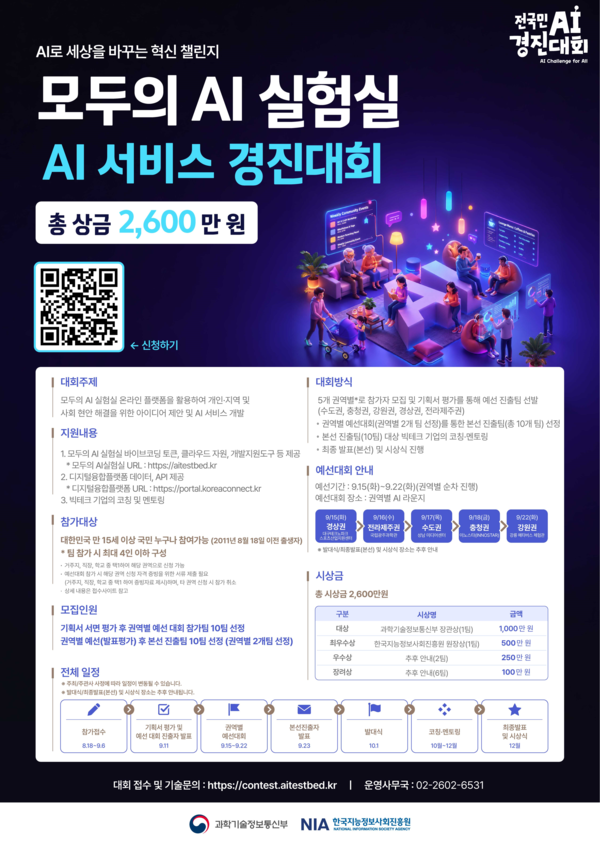
South Korea’s Ministry of Science and ICT and the National Information Society Agency (NIA) said on Aug. 18 they will hold an “Everyone's AI Lab AI Service Competition” in which members of the public develop services using AI.
The competition is part of the “Everyone's AI Growth Ladder project” launched on Aug. 3. It supports participants in turning their ideas into AI services and helps strong ideas lead to start-ups and commercialisation.
The theme is to propose ideas and develop AI services to address personal, regional and social issues by using the Everyone's AI Lab online platform. Anyone aged 15 or older can take part as an individual or in a team of up to 4 people. Applications are accepted until Sept. 6.
MSIT and NIA will evaluate proposals and select 10 teams in each of 5 regions, for a total of 50 teams, for the preliminary round. The regions are the Seoul metropolitan area, Gangwon, Chungcheong, Gyeongsang, and Jeolla and Jeju. After regional preliminaries, the top 2 teams from each region, for a total of 10 teams, advance to the final round.
Final-round teams will receive about 2 months of coaching and mentoring from experts at major domestic AI and IT companies. Organisers will also provide resources needed for service development, including public and private data and APIs, vibe-coding tokens, cloud resources and development support tools.
The grand prize for 1 team includes an award from the deputy prime minister and minister of science and ICT and prize money of 10 million won. The top excellence prize for 1 team includes an award from the NIA president and 5 million won in prize money. Prize money will also be awarded to winners of the excellence prize and encouragement prize. Strong services will receive follow-up support so they can lead to start-ups and commercialisation.
Lee Do-gyu (이도규), director general for information and communications policy at MSIT, said, “It is important to expand opportunities so anyone can learn AI and directly turn their ideas into services.” He added, “I hope participants’ innovative challenges become an opportunity to expand into real services and start-ups and commercialisation.”
 Jin-ho Lee
jhlee26@d-today.co.kr
Jin-ho Lee
jhlee26@d-today.co.kr