
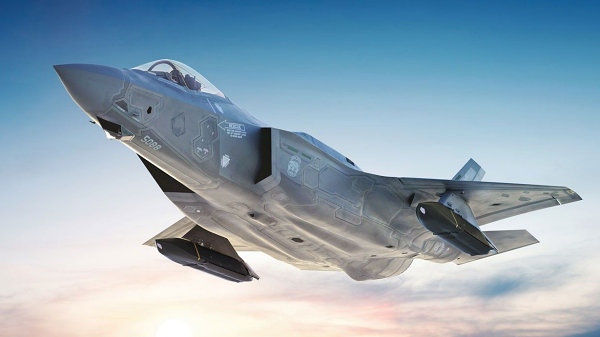
Chinese researchers claim they have developed a lightweight artificial intelligence (AI) system that can identify U.S. F-22 and F-35 stealth fighters through infrared heat signatures. They said it recorded recognition accuracy of more than 90 percent in laboratory conditions. But the system has not been verified using actual fighter aircraft, leaving uncertainty over real-world performance.
According to the IT outlet TechRadar on Aug. 17 local time, the research focuses on using AI to analyse infrared signals produced during flight rather than radar cross-section (RCS).
The F-22 and F-35 are representative stealth fighters designed to reduce the likelihood of being detected by radar and various sensors. But they cannot completely eliminate heat generated by engines, exhaust nozzles and aircraft surfaces. The researchers said AI could distinguish stealth fighters from other flying objects by learning differences in such heat patterns.
The researchers also set a goal of distinguishing fighters from flares. Flares are a common decoy used to disrupt infrared-guided missiles. They explained that AI could differentiate the two because the thermal characteristics emitted by aircraft and flares differ.
Ahn Jang-san (안 장산), who led the research, claimed the lightweight recognition model can maintain high processing speed and identification performance, making it a candidate for use in future air-to-air missiles. He said a lighter system is more favourable for real weapon systems than complex AI models because missiles have limited onboard space and computing resources.
Still, it is difficult to extend the findings to real stealth-fighter detection capability. What the researchers tested were not actual F-22s and F-35s but simulated targets reflecting the two jets' thermal characteristics. The system recorded recognition accuracy of more than 90 percent in laboratory conditions, but operational tests using actual aircraft have not been confirmed.
There are far more variables in real air combat. A fighter's heat signature can change depending on speed, altitude and manoeuvring, and can also vary with viewing angle, atmospheric conditions and ambient temperature. With electronic warfare and various deception measures added, it is hard to be certain that laboratory accuracy would be maintained.
Even so, the research suggests competition in stealth technology may not remain limited to radar evasion. If infrared detection technology is combined with AI, the ability to analyse heat generated by engines, exhaust nozzles and aircraft surfaces could improve.
As AI processors become smaller, there is more room to equip missiles with limited computing resources with machine-learning-based detection technology. As a result, future stealth-fighter design may also be influenced by how effectively heat signatures can be managed, not only radar cross-section.
Ultimately, the core of the research is not that the stealth performance of the F-22 and F-35 has been neutralised. That is because verification using actual fighters is still absent. But it is meaningful in showing that, as technology advances to rapidly analyse infrared signals with AI, the criteria for assessing the survivability of stealth aircraft may expand from low radar observability to include infrared signature management.
 Jinju Hong
hongjj@d-today.co.kr
Jinju Hong
hongjj@d-today.co.kr