
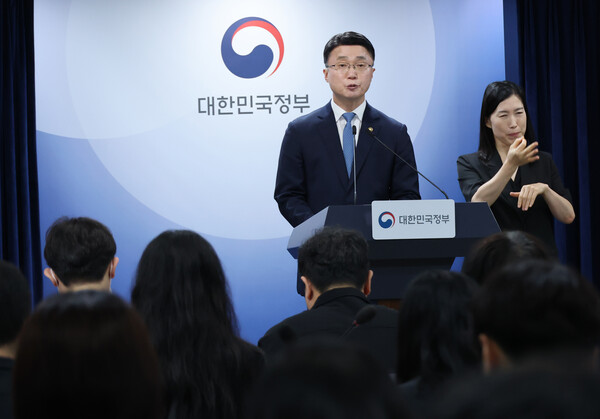
Three companies including SK Telecom, LG AI Research and Upstage cleared the second evaluation of the government-led “sovereign AI project.” Motif Technologies, which entered the competition through an additional call, failed to advance.
The Ministry of Science and ICT and the National IT Industry Promotion Agency (NIPA) announced the results of the second-stage evaluation of the sovereign AI foundation model project on Aug. 18.
Four teams took part in the evaluation: Upstage, SK Telecom, LG AI Research and Motif Technologies.
The ministry said it selected Upstage, SK Telecom and LG AI Research to advance after combining 40 points for benchmark evaluation, 35 points for expert evaluation and 25 points for user evaluation. It used the Artificial Analysis Intelligence Index (AAII), a global AI model evaluation metric, and the NIA benchmark. It also added a process in which members of the public, as well as AI experts, directly use the models and evaluate them.
All four teams’ models were listed as “notable AI models” by U.S. nonprofit AI research group Epoch AI. All four models scored at least 31 points on AAII. The ministry assessed South Korea as ranking third, behind the United States and China, based on top language models by country.
SKT model stands out in math benchmark... Upstage and LG models also pass
SKT’s sovereign AI model “A.X K2” was developed at a scale of 688 billion parameters. It recorded top-tier performance among global open-source models in Korean and math benchmarks. It scored at the gold-medal threshold in an evaluation using 2026 International Mathematical Olympiad problems, and achieved a joint top score of 97.1 percent on the Math Arena AIME 2026 leaderboard based on problems from the U.S. high school math competition AIME.
It also stood out in outcomes for application in industrial settings. An expert committee assessed that A.X K2 secured top comparative performance in mathematical reasoning and Korean, and showed an advantage in usability and practicality as it is embedded in a large-scale commercial service.
Upstage advanced with “Solar Open 2,” a model with 250 billion parameters. As a model optimized for agents, it supports a context window of up to 1 million tokens. It can process documents of more than hundreds of pages with a single prompt. It can run on two Nvidia H200 chips, which also increases cost efficiency.
Upstage received high marks for linkage with real services and with domestically made AI semiconductors. The expert committee positively assessed its plan to connect Solar Open 2 to the portal “Daum” and the “Timely” platform, and its use of FuriosaAI’s neural processing unit (NPU) to reduce dependence on foreign hardware. It also assessed a proof-of-concept carried out in Daum’s service environment as a case combining South Korea’s AI software and hardware ecosystem.
LG AI Research cleared the second-stage evaluation with “K-EXAONE 2.0,” with 750 billion parameters, the largest scale in South Korea. K-EXAONE 2.0 supports 10 languages and applies an Apache 2.0 commercial license. Its overall benchmark performance improved 10 percent from its predecessor, K-EXAONE 1.0.
K-EXAONE 2.0 showed strong performance in reliability evaluation. Among AAII benchmarks, it ranked ninth worldwide on an indicator measuring how well the model suppresses hallucinations that generate incorrect answers to questions it does not know.
The ministry plans to expand support for high-performance GPUs for the three teams that advanced. It will increase support from a level of 768 B200 units in the first half of this year to a level of 1,000 units in the second half, to back development of high-performance sovereign AI models.
The ministry said moves in leading countries to make AI models strategic national security assets are becoming visible. It added that it is deeply aware of the need to develop top-tier sovereign AI models and plans to discuss a new support system that goes beyond existing approaches with relevant ministries and announce details.
 Jin-ho Lee
jhlee26@d-today.co.kr
Jin-ho Lee
jhlee26@d-today.co.kr