
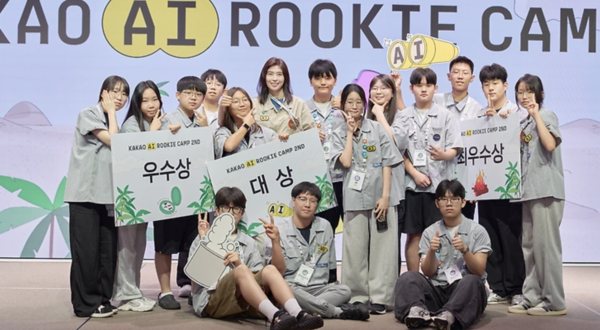
[Digital Today reporter Seok Dae-geon] Kakao has increased the share of hands-on projects in its AI talent development programme for teenagers outside the Seoul metropolitan area. Kakao said on Aug. 18 it held a graduation ceremony for the second "AI Rookie Camp" class on Aug. 14 at its Kakao AI Campus in Yongin, Gyeonggi province. The camp included 100 students from second-year middle school to first-year high school from non-capital regions including Gangwon, Gyeongsang, Jeolla, Jeju and Chungcheong. The camp ran in two sessions from Aug. 4 to 14, each lasting 3 nights and 4 days.
Kakao CEO Chung Shin-a (정신아) attended the ceremony, presented awards to 3 teams for outstanding projects and encouraged participating students. The camp revamped its curriculum to reflect operating experience from the first programme held in February and feedback from participants. While the first programme combined technical learning and projects on site, the second introduced new online pre-learning such as physical AI basics and vibe coding. It created an environment that allows participants to focus more on executing projects on site.
It also expanded hands-on equipment to improve project quality. Kakao prepared various sensors and display modules, a laser cutter, and development boards equipped with cameras and microphones, supporting students so their ideas could be implemented as working prototypes. Students experienced the entire process of developing an AI service, from discovering and defining problems to designing ideas, implementing core functions, completing deliverables, validating from a user perspective and presenting.
At the ceremony, the WE : SEAT team won the grand prize for its "AI Smart Seats for Transport Vulnerable Users." The team presented an operating system that uses AI to efficiently manage seats for transport vulnerable users. It received consistently high scores across evaluation items including the specificity of problem definition, the logic of solution design, and the completeness of technical implementation and validation.
Judging involved a "crew judging panel" made up of Kakao employees and a group of in-service middle and high school teachers called "Rookie Teachers." In particular, "Rookie Teachers," which judged for the first time this year, reviewed not only the technical completeness of the results but also students' thinking and growth potential, including their approach to problems, the design of solutions and actual implementation.
Chung said, "Seeing participating students discover and define problems around them on their own, and turn them into actual outputs, confirmed that teenagers can be problem-solvers who create change in the present, beyond being talents preparing for the future." She added, "The direction of technology ultimately belongs to people," and stressed, "I hope this experience goes beyond using technology well and becomes a starting point for creating solutions to problems they consider important."
 Seok Dae-geon
d2dg@d-today.co.kr
Seok Dae-geon
d2dg@d-today.co.kr