
[DigitalToday reporter Yoonseo Lee] Michael Saylor unveiled a multi-layer "Digital Finance Stack" that positions bitcoin as digital capital and Tether's USDT as a payment method.
A blockchain media outlet, U.Today, reported on Aug. 13 that Saylor designated USDT as a key transaction gateway in the ecosystem.
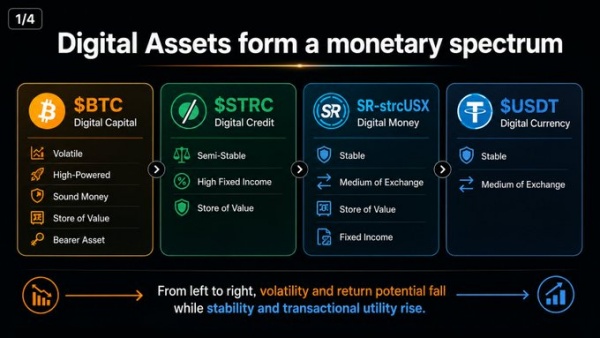
The core is the separation of roles between bitcoin and stablecoins. Saylor designed it so volatile bitcoin serves as digital capital and an ultimate defensive asset, while demand for everyday payments and fast transfers is handled by non-volatile USDT. It effectively integrates Tether's USDT to address the problem that bitcoin's use for payments is limited.
The middle layer includes structured finance products developed by Strategy. STRC is a semi-stable fixed-income credit product composed of the company's bitcoin-collateralized preferred shares, and SR-strcUSX is a hybrid token created to combine the stability of fiat currency with debt-market yields. At the top, "Digital Equity" links each stage into a single business.
The need to expand bitcoin use cases was also stressed. Saylor likened bitcoin to digital capital and explained that innovation turns capital into credit, money and currency. Under this concept, fintech firms can generate profit by operating payment and credit products, and investors can share part of that profit by buying equity.
Saylor's concept is also intertwined with Strategy's financial situation. In a recent report, the company said it sold 6,948 BTC this summer for $432.5 million. The move was intended to pay dividends and maintain liquidity, but the market presented it as the first case of breaking Strategy's long-held principle of "never sell."
In this situation, the new structure is read as an attempt to change how Strategy uses its bitcoin holdings. The company holds 840,447 BTC, and Saylor is seeking to connect them to financial tools that generate payments and credit.
Executives also stressed that the company has not abandoned its stance of buying bitcoin itself. Phong Le (퐁 레), Strategy's chief executive officer, said he expects Strategy to return to net bitcoin purchases by the end of 2026. Still, the announcement has drawn attention in that it shows a direction to restructure the company's massive bitcoin holdings into a fintech infrastructure that can be commercialised, rather than leaving them as a passive asset with high volatility.
Digital Assets form a monetary spectrum:$BTC = Digital Capital$STRC = Digital Credit SR-strcUSX = Digital Money$USDT = Digital Currency From left to right, volatility and return potential fall while stability and transactional utility rise. pic.twitter.com/fBCONStR73
 Yoonseo Lee
yslee@d-today.co.kr
Yoonseo Lee
yslee@d-today.co.kr