
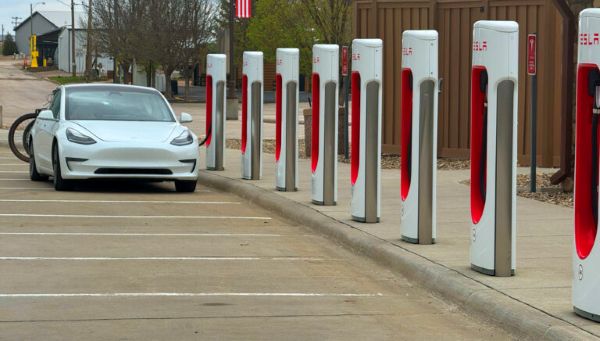
[DigitalToday reporter Jinju Hong (홍진주)] Tesla is pursuing construction of a large V4 Supercharger station in south San Francisco with 124 chargers. The plan would expand major charging hubs that have been concentrated around highways into the city. It is seen as an infrastructure expansion targeting apartment and condo residents who find it difficult to charge at home.
Electrek, an electric vehicle outlet, reported on Aug. 12 local time that Tesla submitted a planning permit to build a Supercharger station on a taxi storage lot near the intersection of Alemany and Bayshore in San Francisco.
The proposal includes 124 V4 Superchargers, power equipment, 28 parking-lot lights and an amenity building of about 400 square feet. The site is a triangular space bordering U.S. Highway 101.
The scale is common at highway rest hubs but unusual in a city. Tesla’s large Supercharger sites with more than 100 stalls have mostly been built near major intercity routes such as I-5 between San Francisco and Los Angeles, or in California desert areas.
Given that existing Superchargers in the San Francisco area have ranged from a handful to a few dozen, the plan marks a significant change. It also differs in that it is a hub aimed at large urban charging demand rather than a station for long-distance travelers.
The backdrop is the Bay Area’s high electric-vehicle adoption rate and its housing environment. Many Tesla drivers live in apartments or condos and find it difficult to install personal chargers, which is seen as driving strong demand for large shared charging facilities.
The use of the V4 platform is also drawing attention. V4 is a next-generation charging platform that supports Tesla’s charging cabinets with output of up to 500 kW. Tesla first began operating a full V4 charging station with such power capacity last year.
The project is interpreted as a long-term infrastructure investment that considers not only current charging demand but also future growth in electric vehicles. The strategy is to absorb urban charging demand by placing a large number of chargers in one location.
Amenities will be provided as well. In the plans, Tesla describes the roughly 400-square-foot building as a “micro amenity.” It will not be a restaurant or large shop, but will include 2 unisex, accessible restrooms, a diaper-changing table, vending machines, storage space, cleaning equipment and rooms for information technology and security equipment.
The vending machines are expected to sell Coty brand coffee and hot drinks, as well as refrigerated and shelf-stable snacks. The building will be designed using white aluminum composite panels, brushed stainless steel, a metal canopy and glass doors.
Ultimately, the plan is expected to be a test of whether Tesla can expand its highway-focused strategy for large charging stations into urban areas. Attention is on whether approvals are granted and how much a 124-stall V4 charging hub can absorb downtown charging demand in San Francisco.
 Jinju Hong
hongjj@d-today.co.kr
Jinju Hong
hongjj@d-today.co.kr