
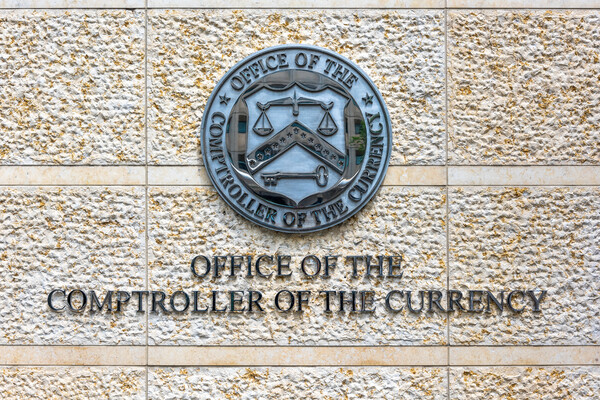
The U.S. Office of the Comptroller of the Currency (OCC) has reaffirmed its plan to promote de novo bank charters, accelerating crypto firms' entry into the federal banking sector. Ripple, Circle, Crypto.com and Paxos have received conditional approval, while Coinbase's charter application is also under review. Competition between the crypto industry and traditional banks is expected to intensify further.
Bitcoin Magazine reported on Aug. 12 that the OCC said it would continue to pursue its policy of encouraging de novo bank formation.
OCC chief Jonathan V. Gould (조너선 V. 굴드) stressed that de novo bank formation is a sign of a sound banking system. He said reforms to the Federal Deposit Insurance Corp.'s process for reviewing deposit insurance applications are also moving forward in tandem with the OCC's expansion of new bank charters.
Gould said regulators have effectively set up barriers to entry for companies applying for federal bank charters and federal deposit insurance. He stressed that companies engaged in legally permitted activities, including digital assets and new technologies, should have a path to become national banks.
The OCC said about 40 de novo bank applications have been filed over the past 18 months. They include cases seeking national trust bank charters for the first time in decades. The OCC said it made decisions on many applications within 120 days after receiving complete documentation.
There was also a case in which a full-service national bank received final approval and began operations for the first time in five years. A representative example is Erebor Bank, backed by Palmer Luckey, Joe Lonsdale and Peter Thiel's Founders Fund.
Crypto firms are also continuing to enter the federal banking system. Ripple, Circle, Crypto.com and Paxos have received conditional approval related to national trust bank charters. The decentralized finance platform World Liberty Financial, backed by President Donald Trump, also applied for a bank charter to expand institutional use of its stablecoin USD1. Coinbase's application is currently under review.
Crypto firms are pursuing bank charters to directly provide custody of customer assets and payment services within the federal regulatory framework. For large operators such as Coinbase, securing national trust bank status could provide a basis for broader custody of institutional clients' crypto assets.
Resistance from traditional banks is a variable. The Independent Community Bankers of America last December asked the OCC to reject Coinbase's application for a national trust bank charter. The group argues that Coinbase has problems with risk management and internal controls and a governance structure that makes independent oversight difficult.
The American Bankers Association also asked the OCC in February to delay reviews of crypto firms' bank charter applications. While regulatory procedures and risk management issues were raised as the apparent points of contention, the industry cites competition over stablecoins and deposit bases as the key source of conflict.
Crypto firms are seeking to offer financial services that differ from traditional deposits, such as providing rewards when users hold tokens. Traditional banks, however, worry that such structures could undermine the competitiveness of bank deposits and accelerate deposit outflows. Despite the backlash, the OCC has maintained its stance of encouraging de novo bank formation and strengthening the competitiveness and resilience of the federal banking system.
Attention is expected to focus on additional charter outcomes for crypto firms, including Coinbase. At the same time, if competition between the crypto industry and traditional finance over stablecoins expands, it could affect the OCC's bank charter policy, making future review outcomes a key variable in reshaping the U.S. financial market.
 Jinju Hong
hongjj@d-today.co.kr
Jinju Hong
hongjj@d-today.co.kr