
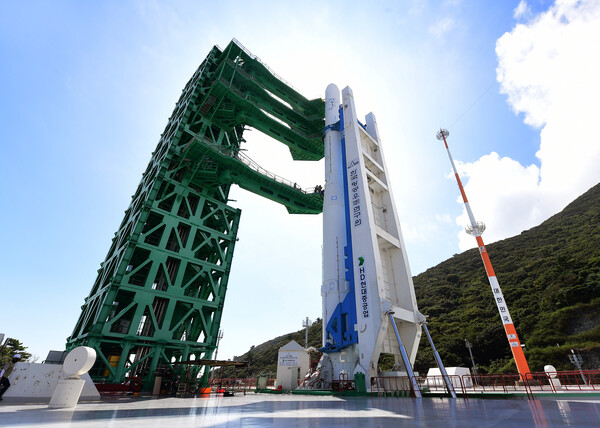
[DigitalToday reporter Jin-ho Lee] South Korea’s Nuriho space launch vehicle is 10 days away from its fifth flight. On Oct. 7, Nuriho will head into space again from the Naro Space Center in Goheung, South Jeolla Province, carrying a record 15 satellites.
The fifth launch is seen as an important turning point for South Korea’s aerospace technology. It will be the first time multiple microsatellites are inserted into orbit in a clustered deployment, and the Korea Space Launch Vehicle Advancement Project running through next year’s sixth launch is also entering its final stage.
Nuriho takes on first satellite cluster mission... five NEONSATs and 10 CubeSats to be deployed
The Korea AeroSpace Administration and the Korea Aerospace Research Institute said the fifth Nuriho launch will be held on Oct. 7 at the Naro Space Center in Goheung, South Jeolla Province. The scheduled launch window is between 12:23 p.m. and 1:23 p.m. The exact liftoff time will be decided by the Launch Management Committee after considering weather and the space environment on the day and the possibility of collisions with space objects.
Nuriho previously completed its fourth launch mission successfully on Nov. last year, placing the Next-Generation Medium Satellite No. 3 and 12 CubeSats into their target orbit. The fourth launch was also meaningful as the first launch in which a private system integration company oversaw manufacturing and assembly of rocket components and jointly participated in launch operations.
The biggest features of the fifth launch are the record number of payload satellites and the first cluster-satellite mission. Nuriho will carry a total of 15 satellites, including five primary payload microsatellites, NEONSAT Nos. 2 to 6, and 10 CubeSats developed by industry, academia and research institutes. That is 2 more than the 13 carried in the fourth launch last year, making it the largest number of satellites Nuriho has sent into space in a single launch.
It is also the first time Nuriho will sequentially insert multiple satellites carrying out the same mission into orbit. The five NEONSATs will separate in different directions at 35 to 40-second intervals to prevent collisions. A new low-shock satellite separation device was also applied to reduce impact during separation. NEONSAT is a microsatellite weighing less than 100 kg each and is equipped with an electro-optical camera with 1-metre-class black-and-white and 4-metre-class colour resolution. Images captured by NEONSAT will be used for disaster response, including national security as well as wildfires and floods.
The final goal is to deploy 10 NEONSATs across two orbital planes. The fifth launch will send the first five, and the remaining five will be added through the sixth launch planned for 2027. Once the 10-satellite system is completed, it will be able to image the Korean Peninsula more than three times a day and observe the same location again within 24 hours. It marks a shift away from simply putting a single satellite into orbit to a system that mass-produces satellites and operates multiple units at the same time.
The 10 CubeSats carried together will also perform different missions. They are expected to be used for verifying space-environment performance of domestically made devices and components, surveying the low-Earth-orbit space environment, monitoring movement of marine debris off Jeju, and analysing fine dust trends and causes, among other tasks.
Rocket assembly in final stage... 76.3 percent of public 'expect success'
At the Naro Space Center in Goheung, final work for the fifth launch is under way. Overall assembly of Nuriho No. 5 began in late June. All payload satellites are installed on the upper stage. The space agency will complete overall assembly by the end of this month and conduct final checks through Oct. 5. If there are no issues, it will move Nuriho to the launch pad on Oct. 6, a day before launch.
Preparations to secure safety during the launch process are also being carried out in parallel. The space agency held a comprehensive launch safety control drill this month involving 12 organisations, including the government, military, police and local governments. It checked controls on people and vehicles around the Naro Space Center on launch day, controls on ships and aircraft along the launch path, resident evacuation and emergency response systems.
Public expectations for Nuriho are also high. In a recent survey of 1,010 households nationwide by the Science and Technology Policy Institute, 76.3 percent responded positively that they expect the Nuriho research and development project to be completed successfully. Those sceptical about the likelihood of success were 1.7 percent. Another 77.0 percent said they would support the project even if its results appear in the distant future. The estimated annual economic and social value of the Nuriho project, calculated by reflecting public expectations of success and preference for long-term value, is about 2.3 trillion won a year.
Nuriho’s challenge will not end with the fifth launch. The sixth launch, the last of the Korea Space Launch Vehicle Advancement Project, is scheduled for 2027. It will carry five primary payload satellites, NEONSAT Nos. 7 to 11, and CubeSats, a domestically made device-and-component verification satellite and an active control satellite will also head into space. Success through the sixth launch would complete the four repeated launch plans that have continued since the third launch.
 Jin-ho Lee
jhlee26@d-today.co.kr
Jin-ho Lee
jhlee26@d-today.co.kr