
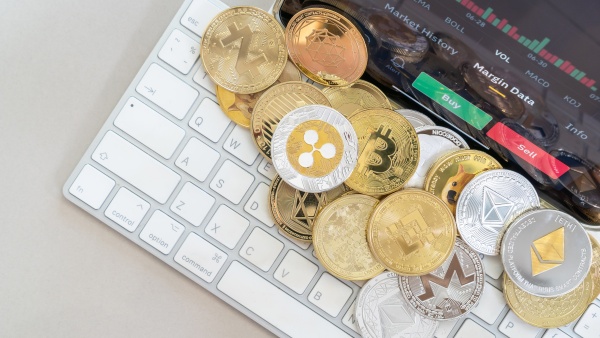
A regular buying strategy of purchasing cryptocurrencies with the same amount each month did not guarantee profits across all assets, data showed. If an investor put $100 a month from 2022 through August 2026, bitcoin, XRP, Solana and Tron delivered gains, but ethereum and cardano ended with valuations below the total invested.
CryptoSlate, a blockchain media outlet, reported on Aug. 8 that CryptoRank data showed an investor who put a total of $5,600 into ethereum over the period had a portfolio value of about $4,898. The loss rate was 12.5 percent. Buying cardano the same way would have left a final valuation of $2,616, a larger loss of 53.3 percent.
By contrast, $5,600 invested in Tron's TRX over the same period grew to $16,521, for a gain of 195 percent. Bitcoin was tallied at $8,660, XRP at $8,465 and Solana at $8,025. All 3 assets posted returns above 40 percent.
The results show that dollar-cost averaging can reduce timing risk but does not guarantee returns. Investors could accumulate more tokens during steep declines, but final performance depended on how strongly each asset rebounded afterward.
Most of the gains were made during the 2024 bull market. Valuations of positions accumulated for more than 2 years rose quickly at the time. As of the end of 2024, the Solana portfolio had climbed to $17,728, XRP to $14,345, bitcoin to $10,193 and cardano to $7,251.
Institutional inflows also increased at the time. The U.S. Securities and Exchange Commission approved a spot bitcoin exchange-traded product in January 2024 and a spot ethereum product in May. As a result, investors were able to access the 2 representative digital assets through regulated investment vehicles.
After Donald Trump won the U.S. presidential election in November, the uptrend strengthened further. Trump has pledged to make the United States a global cryptocurrency hub, pursue a national bitcoin reserve and replace SEC Chair Gary Gensler, who has faced criticism from the industry. After the election victory, bitcoin repeatedly set new all-time highs and inflows into exchange-traded funds also accelerated.
The Trump administration later created a strategic bitcoin reserve and a U.S. digital asset stockpile system, and signed the Genius Act, which includes a federal regulatory framework for payment stablecoins. But as market corrections continued afterward, a large part of the gains built up through regular buying shrank.
Solana fell to $8,025 in August 2026 from $17,728 at the end of 2024, wiping out $9,703. The investor kept buying $100 a month through that period, but the valuation fell by nearly 55 percent. XRP also fell by $5,880 from the end of 2024 to $8,465, and cardano slid to $2,616 after giving back $4,635. Cardano was in profit territory at the end of 2024, but by August 2026 it had turned into a 53.3 percent loss versus the cumulative $5,600 investment.
Bitcoin was relatively resilient. The bitcoin portfolio rose to about $10,800 in 2025, then slipped to $8,660 this year. Ethereum showed a similar pattern. It climbed to $6,501 in 2025 but later fell to $4,898, dropping below the cumulative investment amount.
The U.S. crypto exchange-traded fund market was also affected by the correction. SoSoValue data showed the market size fell to about $92 billion recently from more than $123 billion during the expansion phase. Of that, bitcoin exchange-traded funds hold about $78.3 billion and ethereum products about $10.6 billion.
Tron was an exception. The TRX regular-buy portfolio rose each year to $1,000 in 2022, $3,679 in 2023, $11,032 in 2024, $13,723 in 2025 and $16,521 in August 2026. Unlike other major assets, the year-by-year valuation did not dip even once.
Dollar-cost averaging also showed a loss-mitigation effect. Ethereum's price fell about 50 percent from about $3,770 in early 2022 to around $1,900 in early August 2026. But the regular-buy portfolio loss was limited to 12.5 percent because additional purchases were made at lower prices during the decline. Cardano showed the same effect. ADA fell about 85 percent from about $1.38 to $0.20, but the regular-buy loss rate was 53.3 percent.
Solana was cited as a case where the rebound effect worked strongly in the opposite direction. SOL was still about 59 percent below its roughly $170 level in early 2022 as of August 2026, but the monthly investment result posted a 43.3 percent gain. That was because an investor who kept buying even when it fell below $10 after the FTX collapse came to hold more tokens during the subsequent rebound.
Tron also showed the limits of dollar-cost averaging. TRX rose more than 300 percent from about $0.075 in early 2022 to about $0.33 in August 2026, but the regular-buy return was limited to 195 percent. As prices rise, the amount that can be bought with the same $100 declines, so the gains were reflected less than they would have been with a single purchase early on.
The tally ultimately showed that the strategy was effective for assets that staged a strong rebound after a sharp drop, but for assets with weak recoveries it only reduced losses, and for steadily rising assets it had limits in maximizing returns.
 Jinju Hong
hongjj@d-today.co.kr
Jinju Hong
hongjj@d-today.co.kr