
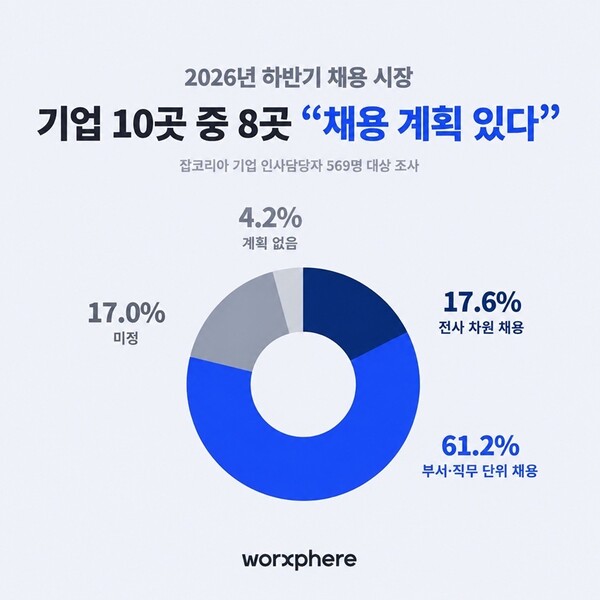
A survey found that 8 out of 10 companies plan to hire staff in the second half of this year.
JobKorea, an AI and data-based HRtech platform operated by Worksphere, surveyed 569 corporate HR managers on hiring trends for the second half of 2026 from July 14 to 31. It found 78.7 percent said they have hiring plans for the second half.
Among them, 61.2 percent said they would fill some positions by department or job function, while 17.6 percent planned hiring at the companywide level. Another 17.0 percent said plans were undecided and 4.2 percent said they had no plans. The share of companies with hiring plans was similar to last year’s survey at 78.3 percent.
The hiring scale has shrunk. Companies citing 10 or fewer planned hires for the second half accounted for 78.9 percent, up 18.4 percentage points from the previous survey. Those planning 11 to 30 hires stood at 8.6 percent and those planning 101 or more were 2.8 percent, down 10.2 percentage points and 4.5 percentage points, respectively.
Budgets have also been reduced. Companies planning a second-half hiring budget of less than 3 million won accounted for 74.3 percent, up 37.5 percentage points from a year earlier. Within that group, 37.2 percent planned less than 1 million won, and 22.8 percent said they would not spend anything, at 0 won. By contrast, companies planning to spend 10 million won or more fell 24.3 percentage points to 13.2 percent.
Hiring timing is being spread year-round rather than concentrated at a specific point. Companies saying they hire on an ongoing basis in the second half were the largest group at 42.6 percent. Those planning to hire from July to September were 29.2 percent, from October to December 17.4 percent, and undecided 10.8 percent.
JobKorea defined the trend of expanding small-scale and ongoing recruitment as “Long-Tail” recruitment. It said hiring scale and budgets are falling, while recruitment that fills needed staff on an ad hoc basis throughout the year is spreading.
Most companies planned small-scale hiring of 10 or fewer, and hiring timing was also found to focus on ongoing recruitment rather than a specific season, supporting the trend, JobKorea said.
In an environment where companies must continue year-round hiring with limited budgets, the use of AI-based recruitment solutions is also expanding. The share of respondents saying they use AI for recruitment tasks rose 46.6 percentage points to 80.8 percent, and 33.2 percent said they leave at least half of the work to AI. When choosing AI recruitment tools, respondents said they considered recommendation and analysis accuracy, at 56.2 percent, the most important factor.
A JobKorea official said the share of companies planning to hire is similar to last year, but the scale and spending budget have clearly declined. In an environment where small-scale and ongoing recruitment is expanding, the official said, matching efficiency that accurately connects applicants, jobs and organisations, and securing flexibility in campaign operations, will determine performance.
 Chi-gyu Hwang
delight@d-today.co.kr
Chi-gyu Hwang
delight@d-today.co.kr