
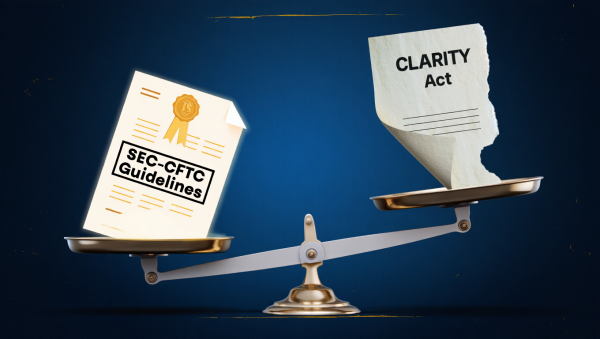
Chris Giancarlo (크리스 지안카를로), a former chairman of the U.S. Commodity Futures Trading Commission (CFTC), said technological innovation in the cryptocurrency industry will not stop even if the Clarity bill pending in Congress does not pass.
On Aug. 3, CoinPost reported that Giancarlo said in an interview on the podcast "The Wolf of All Streets" that the industry should not overestimate the bill.
The Clarity Act is legislation addressing digital asset market structure. It passed the U.S. House of Representatives on July 17, 2025 by 294 to 134, but has stalled in the Senate without proceeding to a floor vote after a Banking Committee vote. With the Senate set to recess from Aug. 10 to Sept. 11, there is only a week left for deliberations.
Giancarlo said innovation in the industry would continue regardless of delays in processing the bill. He said innovation would proceed regardless of whether the Clarity Act succeeds or fails, and warned that if the bill is ultimately scrapped, "the gap could widen between companies that have continued building and those that have not."
He also raised concerns about an expansion of surveillance. Giancarlo pointed to what he called a problematic structure in the Clarity Act that, like the "Genius bill" enacted in 2025, brings cryptocurrency transactions under Bank Secrecy Act monitoring. The Bank Secrecy Act is designed for anti-money laundering, but in practice could lead to broad surveillance of financial transactions, he said. He warned that such a structure could infringe on the secrecy of private transactions guaranteed by the Fourth Amendment to the U.S. Constitution.
Giancarlo said political interests within Washington were playing a bigger role in the Clarity bill failing to gain speed in the Senate. He said it was hard to explain the delays only by ethical issues around the Trump administration, adding that there were more complex reasons beyond White House "own goals." He said there is strong wariness among Democratic lawmakers about primary challenges from left-leaning candidates, and resistance to the shift in control over funding allocation from the government to the private sector.
He also laid out his view on clashes between state and federal governments over regulatory authority for prediction markets. Casinos and sportsbooks are largely retail businesses where operators set the odds and are regulated at the state level, but prediction markets should fall under federal regulation because participants set prices, he said. Giancarlo compared the structure to Uber, which spread beyond opposition from the traditional taxi industry.
Giancarlo said prediction markets are likely to ultimately be handled within a federal regulatory framework. He suggested as a criterion whether participants can choose both sides of a trade, and said that if a product has that characteristic, it is reasonable to classify prediction markets as markets. He also mentioned the possibility that the dispute could ultimately reach the U.S. Supreme Court.
Giancarlo also defended the CFTC's regulatory capabilities. He said that during the 2008 financial crisis, not a single market under CFTC oversight collapsed, underscoring the commission's supervisory capacity. But the CFTC currently has only 1 of 5 seats filled, including Chairman Michael Selick (마이클 셀릭), who took office in December 2025.
Against that backdrop, regulation of stablecoins is also tightening. The U.S. Federal Reserve jointly released with other authorities a regulatory proposal targeting issuers of payment stablecoins, and outlined an approach that would require bank-level customer due diligence in line with implementation of the Genius bill. Regardless of the Clarity bill's fate, U.S. digital asset regulation is moving toward reshaping both market structure and transaction surveillance, leaving that as a point to watch.
 Yoonseo Lee
yslee@d-today.co.kr
Yoonseo Lee
yslee@d-today.co.kr