
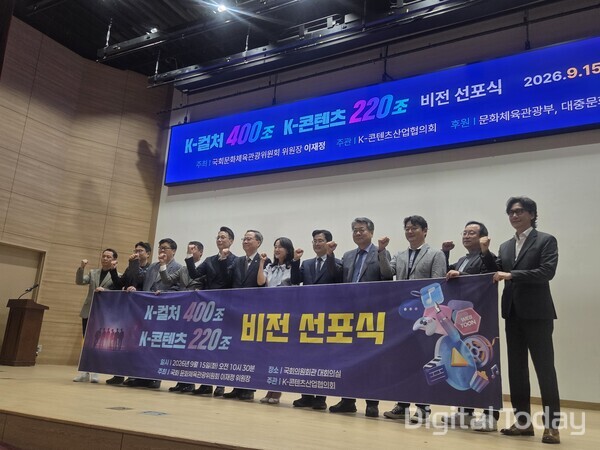
Eleven associations representing South Korea's content industry, including games, films, dramas, music, webtoons, publishing and animation, set a joint target of 220 trillion won in K-content industry sales and $27 billion in exports by 2030 and called for a sweeping overhaul of tax, financial and legal systems.
The K-Content Industry Council held its inaugural general meeting on Sept. 15 at the National Assembly Members' Office Building and staged a 'K-Culture 400 trillion won, K-content 220 trillion won vision declaration ceremony'. It released the 'K-content 220 trillion won 2030 vision report' and proposed policy tasks to meet the goals.
The council elected Kim Tae-heon (김태헌), chairman of the Korean Publishers Association, Cho Young-ki (조영기), chairman of the Korea Association of Game Industry, and Woo Seung-hyun (우승현), chairman of the Korea Music Content Association, as co-chairs. The voluntary consultative body launched in May last year was converted into an official council joined by 11 associations.
SALES SEEN RISING TO 220 TRILLION WON FROM 161.5 TRILLION WON; OVERSEAS MARKETS AS GROWTH ENGINE
The council's 2030 targets are 220 trillion won in sales, $27 billion in exports, 750,000 workers and 146,000 companies.
To reach the targets, sales must grow 6.4 percent a year from 161.5 trillion won in 2025, and exports must rise 12.6 percent a year from $14.91 billion. The number of workers is targeted to increase to 750,000 from 693,000 in 2025. The number of companies is targeted to rise to 146,000 from 121,000 in 2024.
It set the export growth rate at about twice the sales growth rate. That means it is seeking growth momentum from expanding overseas markets. Sales of 220 trillion won account for 55 percent of the government's 2030 goal of 'K-culture 400 trillion won'.
The problem is that it will be difficult to meet the targets under the current policy stance.
A mid- to long-term outlook model presented by Song Jin (송진), head of the policy research division at the Korea Creative Content Agency, at a parliamentary forum hosted by lawmaker Kim Jae-won (김재원) projected that if current policy and budget levels are maintained, 2030 content industry sales would reach 205.9 trillion won and exports would total $18.7 billion. Even if content-related budgets rise 10 percent each year, sales would be 215.3 trillion won and exports $19.18 billion, falling short of the targets.
The council argued that beyond fiscal expansion, the tax system, finance and legal framework must be revised together to draw out private investment and the industry's capacity for growth.
Kim Seung-wook (김승욱), executive director for policy at the Korean Publishers Association, said, "If you leave this structure as it is and only increase the budget, it is like putting more cars onto a clogged road." He said, "It is not about how much more to support, but about what must be changed."
TAX CREDITS, POLICY FINANCE, AI AMONG 6 COMMON TASKS
The council presented 6 common tasks: a full expansion of tax credits for content production costs, expanded policy finance, improvements to flexible work arrangements, promoting an AI transition and protecting creators, boosting content demand, and building integrated governance and an export support system.
It first called for expanding eligibility for production-cost tax credits, now focused on video content and webtoons, to the full range of cultural content such as games, music and publishing. Games account for 57.7 percent of total content exports but are excluded from production-cost tax credits, and music, which recorded the highest export growth rate in 2025, is also excluded.
On policy finance, it proposed creating genre-specific specialised accounts within the culture account of the fund of funds, and strengthening equity investment and guarantees. Improving flexible work arrangements to reflect an industry characterised by project-based production was also included as a task.
For AI, it presented 3 principles: "transparency" in disclosing the sources of training data, "compensation" in paying appropriate remuneration for commercial use, and "accessibility" in supporting lawful data use by small and medium-sized producers.
To expand domestic demand, it also proposed increasing the cultural voucher programme from about 270 billion won to around 1 trillion won and broadening eligible uses to include games, webtoons, e-sports and online video.
"INDUSTRY SHOULD LEAD"; IMPLEMENTATION STATUS TO BE DISCLOSED EACH YEAR
Lee Jae-jung (이재정), chair of the National Assembly's Culture, Sports and Tourism Committee, stressed the significance of the content industry's ability to speak with a unified voice with the launch of the council and said, "The National Assembly will follow a half-step behind. Please have the industry lead first."
Kim Young-soo (김영수), first vice minister at the Ministry of Culture, Sports and Tourism, said the ministry's proposed government budget for next year increased to the 9.6 trillion won range from the 7.8 trillion won range this year, but it may not be enough to resolve all structural difficulties facing the content industry. He said the ministry would reflect on-the-ground tasks in policy through communication with the council.
Kim said, "We in the industry will make the 220 trillion won," and asked the government and the National Assembly to help build the industry foundation, including tax, finance and legal systems, to make the target achievable.
The council plans to review the previous year's performance based on Korea Creative Content Agency statistics and publish a 'K-content 220 trillion won implementation review report' every year.
 Lee Ho-jung
lhj@d-today.co.kr
Lee Ho-jung
lhj@d-today.co.kr